skip to main |
skip to sidebar
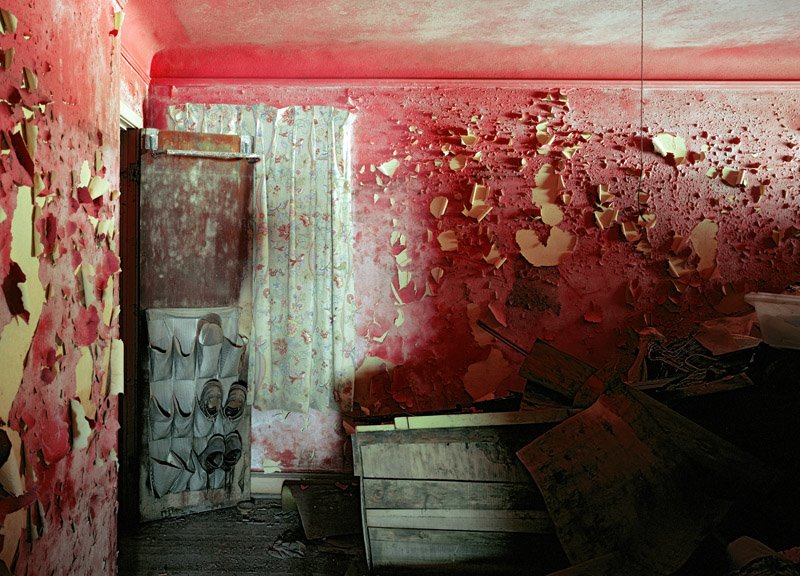
 As Katrina has been on my mind alot for the last year and obviously this week, it was not such a surprise to learn that Robert Polidori has a new series of New Orleans centered on the disaster. The pictures are due for exhibition this fall at the MET. There is a short interview with the photographer at Art:INFO. Several knockout thumbnails are included of homes decomposing in the aftermath of the storm throughout this past year. They are beautiful, horrifying and fascinating works. Poverty and decay seem to have a way of preserving the strangness of the "past". Polidori has some interesting insights into artmaking and photography.
Here's a sample of the interview:Something that has always struck me about the high level of detail that you’re talking about in your work is that it allows you to make your pictures more telling in psychological terms.
Yes, I think so. When images are soft, they just remain evocative, or in your imagination. You get a mood, and it remains on the emotional level. The viewer has to put more of him or herself into it. When there is more detail, it’s like that old expression: There’s no fiction stranger than reality. Reality will compose the most extreme paradoxes and contradictions and adjacencies, which can’t be understood.
So detail gives you more mental work to do. There are more things to look at, which suggest more and more questions. All that mood is still there anyway, so it’s like the double-punch effect. It’s a question of keeping the mind occupied while the emotions are being silently manipulated on the back burner. I just think it makes for a richer experience. And it has the added value of being a more accurate historical record. So you have something for everybody.
And how does that relate to the pictorial sophistication of your images?
I’m not one of these artists who’s making art about the processes or the rules of art-making. I’m not interested in that. I think that that’s been gone through, and I think that it’s one dimensional. It’s not about art-making. However, there are aesthetic principals there, pictorially speaking. The grammar of my pictorialism comes from pre-Renaissance and Renaissance perspective, because all of that stuff is built into modern lenses. So that is assumed in the technology that I use.
What would you say was your basic reason for taking photographs?
I don’t take photographs because I love doing it (though I don’t hate it). Some photographers are in love with the process of taking a picture. Psychologically, I’m more interested in the situations that taking the picture puts me through, and what it forces me to witness. I really do it because I want that picture. It’s like I’m collecting evidence, like a detective looking to solve a case. I don’t mean that literally, but I use it as a simile. It’s a thing about phenomena and asking questions. And answering some, but not answering all of them.
Yes, I see that. It’s like you were saying earlier about reality’s paradoxes. It seems to me that this is what makes these New Orleans pictures so poignant. Each image presents the evidence of someone’s neat and ordered life that’s just been turned upside down.
Yes, it’s imploded. I’m interested in interiors, and I have been for a long time, simply because they’re indices of individuals’ personal values. They tell you a lot about the individual. Like I’ve said before, to me interiors are both metaphors and catalysts for states of being. You can take a portrait of somebody, and you might have a feeling looking at their face, but you know less things about them by looking at their face than you do when you look at the way that they compose their own interior space. What interests me are their values.
image: Robert Polidori
 J, Murph and Lou descended last night like a fury. Mascis is a white haired wizard, a true guitar God! Damn it was amazing! For the old geezers "Forget the Swan" was definitely the highlight.
Brilliant.
 *Please note. Tonight is Spike Lee's When The Levees Broke on HBO. I saw it last week and it is frankly his greatest artistic achievement, heroic actually. For every American, a stark reminder of our national shame and our fragile nature. Warning, this is real documentary so be prepared to get upset. Think of these people when you vote in November and don't forget those in the Gulf Coast.

There's great little piece at the Philadelphia Enquirer on the use of dirty words and the wild variations from culture to culture. Its seems, universally that people like to use sexual words to express their anger or agression towards another. It seems that most taboo expression is rooted in spiritual superstition and elaborate rules about mixing sex and speech. For Americans, FUCK is still the supreme being as if we needed reminding. What I didn't know is that word is 1000 years old and pretty much the king of the hill for the last 400 years. It has nothing to do with "for unlawful carnal knowledge"! The sad part is, that experts are concerned that its over usage may deem it mute. Wouldn't that be horrible!

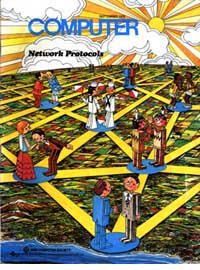
Chris Jagers just turned me on to the Computer History Museum
and its Internet History exhibition. The drawings / sketches for the preliminary designs of the "Arpanet" are amazing and wildly simple when compared to what we have come to know and use as the internet today. In addition there are some cool code thumbnails and of course the always super "sci-ficomputer systems of the 1960's and 1970's. You really have to go through each decade to see how such a simple network idea can blossom. Artist's should really look closely at this as it certainly relates to how ideas develop "outward" The show is truly quite fascinating stuff when you consider the creativity involved. I'm amazed at the nostalgia I have for the machines too- most of which I have never even used!
This is another excellent compendium to these earlier posts: 15 Megs of Fame and the Pew Blogger Survey.
image: Computer Magazine 1979
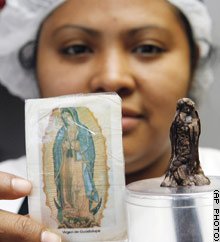
 Yes Mary has arrived once again and her chosen medium? it's not wood, it's not a mushroom, -It's a chocolate dripping!
FOUNTAIN VALLEY, California (AP) -- Workers at a chocolate company have discovered a 2-inch-tall (5-centimeter-tall) column of chocolate drippings
Just when you start to loose faith in the world....
here's the link at CNN for the full disclosure.
 go ahead, meet your inner Pollock
(
hint-just move your cursor or any key)
 So with some time off this week I have managed to get back to the paint. It's been a good few days and I'm starting to get that edge back, the sense and focus that only comes from daily practice. It hasn't been easy with all the international calamity that continues to creep and seep into every crevice - and the movie being filmed on my block only adds to the cacophony - but some brights spots have emerged such as the Ned LaMont victory and well being able to paint regularly. With 10 hour days in studio you get to shuffle through yer shit - figuratively and literally - always coming upon some arcane part of your history.
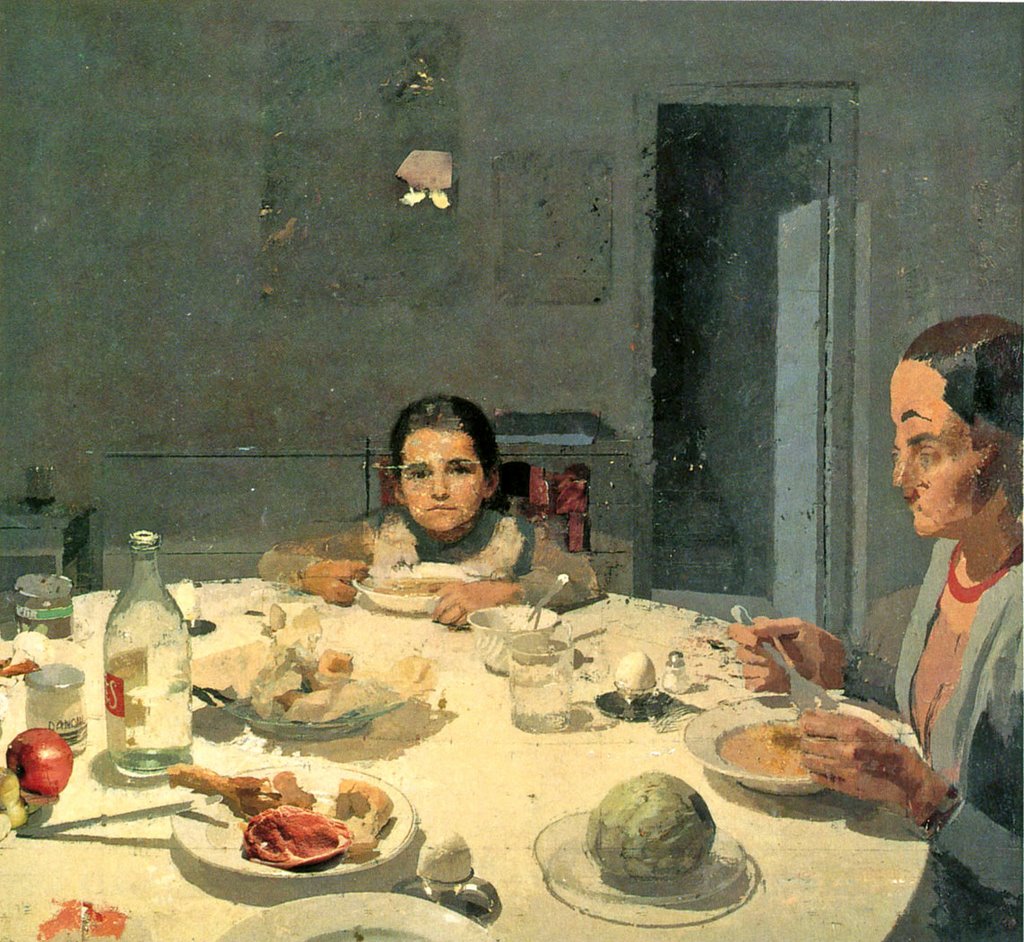
The image above has been with me in my studio for roughly 12 years, pinned onto and under various competing pictures and ephemera for the purpose of clueing me into something when I get stumped. I haven't noticed it much lately but today it jumped forth as it has many many times before.
The painting is titled, La Cena and is by the Spanish realist, Antonio Lopez Garcia. I've never seen it in person though I have seen a dozen or so paintings of his in the flesh. Doesn't seem to matter though because it always feels real even as a color copy - something I'd argue to be fascinating in itself.
At the time of this reproduction the work was unfinisihed, and I personally hope it is still just as unfinished/finished as it appears here. It's a masterpiece. That being said, I could see it continuing on its journey forever, changing each season for the entire duration of the artist's life. Always holding some new light, a variation here and there, cradling a new edge of investigation. The same scene forever still but always moving in place. The phenoma themselves fully seen and continually reassesed, painstakingly. It is such an anti-media piece, this is the no-frills Spanish painting tradition.
There is generosity in this picture, the slightest detail is given great egalatarian regard. Everything matters here, the tiny flourishes and modulated pigments are graces in themselves- interlocking, never shouting, always becoming the everyday, always inconclusive. Which is to say the real event.

It’s been record heat the last two weeks nationwide and admittedly, last week in NYC felt like hell at times. Staying focused and for that matter hopeful hasn’t been easy with many personal setbacks and no less a new battle with Verizon, an old nemesis when it comes to consistent communications. Needless to say I have been beset by negativity and at times despair over being a working artist who is frankly not getting ahead – yet trapped in a maze of constant activity, where the pursuit of intangibles feels so obscured by the daily grind of work, commuting, and bill paying.But I’m lucky, as most of us are, quite lucky, quite privileged in many or all regards. Sure I have a nameless role in an organization that supports artists across the country and the world at large- an occupation where I am under payed, overworked, and never appreciated by all parties involved in the equation. I can say the same for most of my co-workers on that front too. I am however alive today. I am not maimed by the bombs that are destroying countless lives throughout Lebanon, Iraq, and Israel. Countless blogs have been posting from within and without Lebanon over these last 3 weeks and to read them is sobering – achingly sobering. The same can be said of the Iraqi blogs that have been able to maintain themselves through 3 years of endless bloodshed and broken promises. These are testimony to the human spirit in contrast to the nightmare of human political enterprise.In the course of these 3 weeks I have seen a groundswell of anti-Israeli graffiti spring up around me. It’s plastered all over the subways, in the elevators and hallways of the buildings that are part of my normal routine. Somewhat reminiscent of similiarly angry tags that sprouted from the 911 tragedy – political critique bordering on hate and some outright hate.Its hard to even fathom what Israeli generals think they are accomplishing with a brutal campaign against civilians or what Hezbollah thought they would succeed in doing with that ill advised “border crossing” three weeks back. On one level it was surely a test of PM Olmert, to see what the new guy was made of. Well now we know, an iron fist. It seems a marked departure for one of the architects of the Gaza West Bank pullout. It’s difficult to watch the agony of the civilians in Lebanon. They have now suffered decades, prisoners to other people’s wars- Syrian, Palestianian, Iranian, Israeli. Historically, today seems all too familiar for such a small country.As the shelling continues Pope Benedict and Ayatollah Sistani have both repeatedly called for a ceasefire. Both have been met with silence and perhaps a political lesson. The real powers don’t want to hear from them unless they can be used in a rhetorical moral battle to stir up unmitigated hate from the unwashed masses. If it’s a call for peace or level headedness, then these men are quickly reminded of how antiquated their social and spiritual role actually is within the world of real politik. It’s a disgrace in itself as both represent millions – singularly and collectively.So what is behind this – a war which seems more planned than reactionary?Is it the Judeo-Christian hate machine unleashed as so many taggers want to purport? Doubtful as an awfully large number of Christians are the victims. These are a segment of Middle Eastern culture almost always forgotten by the right and left, and far too often squeezed out by the competing interests of Sunni, Shia and Israeli. Where are all the evangelicals- Dobson, Falwell, Robertson? Only the Pope has spoken for these people. I presume the rest are consumed by their Christian-Zionism, their lust for armageddon. Their peculiar brand of nihilism wants more than anything to find secret knowledge within the events of this war – that secret knowledge being arcane “prophesy”. This theological/political obsession of “end times” precludes them from seeing the human tragedy that is unfolding at an alarming pace.What does feel likely to me about all of this is that this is perhaps the first real all out war over resources. This will become regional quickly. A lot of parts of the puzzle are coming together now. This is a core versus periphery conflict and the prize is natural gas and oil reserves. Iran has the second highest of both in the entire world. Look at some recent events. The Saudis just made two multi $billion arms deals with France and the US. Iran has made similar deals with Russia and Venezuela.China has wooed Iran as well, making efforts to step up its presence in the Middle East as well oil rich areas of Africa. You can feel the polarization happening pretty quickly. India is a player here too. Iran, by luck or sly design is ready to make a push to be the regional power. It is their historic time and in some Shia minds, a theological destiny to reclaim the upper hand within Islam itself. The Saudis seem to be stockpiling as a precaution as they and Israel are the only true roadblocks to Iranian regional dominance. Iran knows where they fit on the Neo-Con roadmap – the bull’s eye. Thus they have made fast friends with Security Council members, China and Russia. It’s not just about business and nuclear power, but political clout and personal protection. This all is a prelude to war with Iran – you can count on that war unless cooler heads come to surface. The stakes are high – energy supremacy for the next 40 years. So what of Israel? Well many of my Israeli friends will quickly say this is about their own survival and that Olmert is just showing their strength (and I’d argue their weakness). I know several people who will perhaps be called up from reserves if this doesn’t stop soon. Many of their peers already have. It’s a depressing thought.Israel has its personal reasons, its grudge against Hezbollah(and by extension Hamas) but who is allowing this to continue on? The Neo-Con agenda as executed by various principals here in the US and Britain. It’s a gamble for sure. They think that through destruction they can implement their utopia of proxy states. Funny how they repeatedly like to gamble with innocent lives and if it fails? Well then just retreat to some think tank or corporate board unscathed.Lebanon is the direct ticket to Syria and the quite weak Assad. If Syria can be dismantled along with Lebanon then it creates a vacuum (one which will bite us in the ass) that can be filled by pro-US/EU interests as a counter point to Iran.When will people learn that this never works? It simply creates more enemies and failed states. All these plans are implicitly immoral and incompetently executed to add insult to injury. Regular people suffer – and for generations. It’s a dangerous game for all players because the balance and luck can quickly tip out of control. The Middle East is full of angry, impoverished people – most under the age of 30. These forces can quickly be armed by outside interests of all stripes.If only Democracy were the goal – but that’s just the tag line to mask the drive for natural resources. Democratization comes about culturally, not militarily. We’re obviously running out of natural resources. Allies are no longer enough. Corporate interests want direct control of the oil and more importantly gas resources. That is the only sure way to manage the coming energy demand and remain profitable. It’s pretty obvious that was the Cheney doctrine in Iraq and Halliburton/KBR’s no bid monopoly on the oil wells and pipelines. I’m sure it informed his request of President Clinton, while CEO of Halliburton, to end the sanctions against Iraq and his request to open up talks with Iran for the purpose of energy trade. If only this energy were put into renewable energy, diplomacy and technology. There is an irony here within the Neo-Con Middle East agenda. The invasion of Iraq actually produced a desired effect. Iran was rattled, and through the Swiss sought to go to the table with the Administration and the State Department. It could have been an opportunity to quell nuclear ambitions and make progress on other fronts. Our arrogant leadership rebuffed. Around this time Syria also leaves Lebanon as its foreign controller signaling its own political weakness within the region and its fear of invasion -a situation that is now become obsolete and squandered. Why? Because months later due to lack of forces and leadership, we became bogged down in a sectarian/civil war in Iraq. Iran has realized its new position as a leader with few restraints. Syria now thinks it acted too quickly and Assad has internal political pressure to reassert Syrian influence in Lebanon. Our military is now surrounded by enemies and battered after 3 years of futile fighting and rebuilding within Iraq. Israel is sending a message of defiance to its neighbors – do not seize the opportunity to assert regional dominance.Meanwhile back in America, 50% of the population is still pre-occupied with those missing WMD’s that Saddam so skillfully hid or whether or not the attacks in Haifa are Biblical prophesy.Israel seems to be making the same mistakes of the Bush camp, destroying so many innocent lives while killing any prospects of public agreement. These words seem to have been forgotten and need to be reconsidered.Israeli PM Ehud Olmert, while Mayor of Jerusalem:
"Political leaders can help change the psychological climate which affects the quality of relationships among people." His speech concluded with reflections on the importance of political process in overcoming differences: "How are fears born? They are born because of differences in tradition and history; they are born because of differences in emotional, political and national circumstances. Because of such differences, people fear they cannot live together. If we are to overcome such fear, a credible and healthy political process must be carefully and painfully developed. A political process that does not aim to change the other or to overcome differences, but that allows each side to live peacefully in spite of their differences."
In closing, I think is a helpful read, Ending the Neo-Conservative Nightmare, by Daniel Levy.
Here's a place to help those suffering in Beirut.
image: Dan Perjovschi
...that this is the person speaking for us right now during a very serious meltdown in the Middle East. Karen Hughes, is the official in charge of public diplomacy to the Muslim world. How many miles from Normal now?
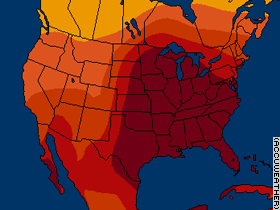 Looks like a Red State sensation sweeping the nation!Who wants to put money on the NYC Blackout of 2006?I'm betting its starts around rush hour tomorrow....
its only the natural summer cycle for you enviro-fascists out there - 110 is normal for the northeast.
A really interesting report was published Pew Research a week or so ago on the general makeup of bloggers in the U.S. This is a great bookend to the Economist's New Media Survey from some months back.
Pew states the following:
A national phone survey of bloggers finds that most are focused on describing their personal experiences to a relatively small audience of readers and that only a small proportion focus their coverage on politics, media, government, or technology. Blogs, the survey finds, are as individual as the people who keep them. However, most bloggers are primarily interested in creative, personal expression – documenting individual experiences, sharing practical knowledge, or just keeping in touch with friends and family.
Here are some highlights from the Pew pdf, which is well worth the read.
While many well-publicized blogs focus on politics, the most popular topic among bloggers is their life and experiences.
The Pew Internet Project blogger survey finds that the American blogosphere is dominated by those who use their blogs as personal journals. Most bloggers do not think of what they do as journalism.
Most bloggers say they cover a lot of different topics, but when asked to choose one main topic, 37% of bloggers cite “my life and experiences” as a primary topic of their blog. Politics and government ran a very distant second with 11% of bloggers citing those issues of public life as the main subject of their blog.
Entertainment-related topics were the next most popular blog-type, with 7% of bloggers, followed by sports (6%), general news and current events (5%), business (5%), technology (4%), religion, spirituality or faith (2%), a specific hobby or a health problem or illness (each comprising 1% of bloggers). Other topics mentioned include opinions, volunteering, education, photography, causes and passions, and organizations.
The blogging population is young, evenly split between women and men, and racially diverse.
The following demographic data comes from two surveys of internet users conducted in November-December 2005 and February-April 2006 (n=7,012).
The most distinguishing characteristic of bloggers is their youth. More than half (54%) of bloggers are under the age of 30. Like the internet population in general, however, bloggers are evenly divided between men and women, and more than half live in the suburbs. Another third live in urban areas and a scant 13% live in rural regions.
Another distinguishing characteristic is that bloggers are less likely to be white than the general internet population. Sixty percent of bloggers are white, 11% are African American, 19% are English-speaking Hispanic and 10% identify as some other race. By contrast, 74% of internet users are white, 9% are African American, 11% are English-speaking Hispanic and 6% identify as some other race.
Only one-third of bloggers see blogging as a form of journalism. Yet many check facts and cite original sources.
34% of bloggers consider their blog a form of journalism, and 65% of bloggers do not.
57% of bloggers include links to original sources either “sometimes” or “often.”
56% of bloggers spend extra time trying to verify facts they want to include in a post either “sometimes” or “often.”
Bloggers are avid consumers and creators of online content. They are also heavy users of the internet in general.
Fully 79% of bloggers have a broadband connection at home, compared with 62% of all internet users. This high-speed access translates into heavy media consumption and creation.1 For example:
95% of bloggers get news from the internet, compared with 73% of all internet users.
77% of bloggers have shared their own artwork, photos, stories, or videos online, compared with 26% of all internet users.
64% of bloggers say they go online several times each day from home, compared with 27% of all internet users.
Bloggers are major consumers of political news and about half prefer sources without a particular political viewpoint.
72% of bloggers look online for news or information about politics; by contrast, just 58% of all internet users do so.
45% of bloggers say they prefer getting news from sources that do not have a particular political point of view; roughly the same percentage of the general internet population agrees.
24% of bloggers prefer political news from sources that challenge their viewpoint; and 18% choose to use sources that share their political viewpoint. Again, bloggers’ responses are similar to those of the general internet population.
Bloggers often use blog features that enhance community and usability.
Community-focused blogging sites LiveJournal and MySpace top the list of blogging sites used in our sample, together garnering close to a quarter (22%) of all bloggers. Features such as comments, blogrolls, friends lists, and RSS feeds on these and other blogging sites facilitate a sense of community and offer readers additional ways to receive and interact with the blog’s content.
87% of bloggers allow comments on their blog.
41% of bloggers say they have a blogroll or friends list on their blog.
Only 18% of bloggers offer an RSS feed of their blog’s content.
 This is the third installment of "Alien Intelligence". (see post1 and post 2) Although many have come to some conclusions, I’m going to proceed with this.The subject of decline and mediocrity began with a discussion of Eric Larsen’s book A Nation Gone Blind which has been covered here, here, here , here and here respectively by Deborah Fisher and Christopher Jagers. In my previous posts I presented Morris Berman’s Twighlight of American Culture as an older and distinct investigation into the subject of collapse which I am admittedly, slavishly delving into quite deeply.
The subject of collapse was recently cited by Tyler Green in an interview with mnarts.org:Tyler Green in response to this question: What is the single non-art-world factor that is the greatest influence on art made today? (For instance, environmentalism, animal rights, worldwide feminism, the spread of digital technology?TG: This is a big and excellent question. Degeneration, particularly of societies, cultures, and political systems. Regardless of whether I’m in New York, LA or in between, I see artists making art about things falling apart. Look at last year’s top news stories: Iraq, Katrina, the London bombing, the Indian Ocean tsunami, the BTK serial killer, the continuing struggles of the Bush presidency, even the death of Terri Schiavo. They’re all about degeneration.I’m surprised that no contemporary art curator has seized on this and created a big group show about it. It could be a great example of an artist-driven show that mixes contemporary art with contemporary life. “Alien Intelligence II” left with this synopsis from Morris Berman:The conclusion is that there are 4 basic tenets of collapse:1. Accelerating social and economic inequality2. Declining marginal returns with regard to investment in organizational solutions to socioeconomic problems3. Rapidly dropping levels of literacy, critical understanding, and general intellectual awareness4. Spiritual death – that is, Spengler’s classicism: the emptying of cultural content and the freezing (re-packaging) of it in formulas- kitschBerman continues with his parallel of the contemporary situation with that of that late Roman Empire. We have heard this sort of thing a lot but look at just these brief but striking parallels:“During Nero’s rule all taxes were going to the military and all land in the empire was owned by 2000 men. The economic and cultural life of the cities collapsed for lack of funds. For centuries the aim had been to Hellenize or Romanize the rest of the population – to pass on the learning and ideals of the Greco-Roman civilization. But as the economic crises deepened, a new mentality arose among the masses, one based on religion, which was hostile to the achievements of higher culture.”We see this played out in Islam over the past couple of centuries and a parallel dynamic which began to gain strength within the US during the 1970’s evangelical movement. The American fundamentalist movement also happens to parallel the steady decline of middleclass incomes as a result of the shift from a manufacturing economy to a service and investment economy. Hostility towards intelligence is now a part of American political culture as well as the culture at large. Amazing how powerful politicians such as Tom DeLay, the mainstream media, Mega-Churches and the general pop citizenry call intellectuals – who have no power at all – elitist, or worse. Yet somehow remain ignorant or silent on the real elitists – the oligarchic class, the “corporate hegemony”. Berman: “A concern for literacy and critical thinking is only democratic. Society can’t function if everyone is stupid. Dumbing down is the formula of a doomed society and not a vital one.” Berman continues:“This was the most conspicuous development in the ancient world during the Imperial Age, primitive forms of life finally drowning out the higher ones. The truth is civilization is impossible without the hierarchy of quality. By the Third century if not before, there was an attitude among many Christians that education was not relevant to salvation, and that ignorance had a positive spiritual value”. We hear this echoed directly and indirectly so often now. Even more ominous is the Christian marketing and consumerism that is on the rise. People are increasingly equating their spiritual life with materialism and economic gain. It is no so distinct from what you see in the secular church of the Artworld. Interiority is now discarded for more outward rituals of acquisition, spectacle and praise. Money as proof of spiritual success or Godly favor seems to be the perverse message that is now being accepted by millions under the guise of “investing” in likeminded, faith-based products and politics. It’s a dangerous breeding ground and a certain death for any mainstream Faith not mention cultural freedom as a whole. We certainly see the rise in “mysticism” throughout popular culture and a general belief in special knowledge – a knowledge by revelation (Da Vinci Code, all the bad psychic TV shows). Americans overwhelmingly believe in angels and overwhelming reject Evolution.Retruning to “Twilight” - Berman looks at structural inequality first. World Systems analysis contends that world inequality is structural. To paraphrase, this draws the distinction between core and periphery. Core countries are those in privileged of the northern Hemisphere such as the United States and Western Europe (increasingly China). In these regions financial, technical, and productive power is concentrated power – power controlled by an elite. The periphery on the other hand contains exploited regions that sell their resources and labor to the core without ever having access to the latter’s wealth. The enrichment of the core is structurally dependent on the impoverishment of the periphery.Ex. Pacific periphery: Burma, Thailand, Malaysia, Indonesia, etc. EU Periphery: Africa, Middle East US Periphery: Central and South America, Middle EastThe structural inequality that we see or don’t see today, in what is likely the third and perhaps final wave of globalization, is argued by Christopher Chase Dunn to have “its historical roots in the “Commercial Revolution of the 16th century – plunder of the Americas was crucial to the emergence of industrial capitalism in the core, and the direct use of coercive force eventually evolved into institutionalized economic power based on law and private property”Berman adds that today “a network of independent markets is the main glue of our global system, bolstered, when necessary, by the military power of the core states. Today the political coercion coming from the core has become less central to the structure of exploitation and the domination, since the core can rely on local coercion – that is authoritarian client states in the periphery to do its dirty work in exchange for economic aide to the elite in the periphery. Economic exploitation, organized through the production and sale of commodities, is a more effective, less dirty means of control."
Think - World Bank, IMF, NAFTA, GATT, etc. I think it is also important to notice how Saudi Arabia and Israel are used within the Middle East and directly benefit from $billion arms deals from the US and the EU. They are the strongmen in the region but it remains to be seen as to how wise or applicable this will be in the long term – history has a way of biting back.It's easy to recognize these patterns of coercion and influence within periphery zones, especially as it relates to shrinking energy sources and the desire to open new international trade markets and exploit cheap labor to those ends. This seems a natural extension of colonial structures that worked largely to do the same albeit for more nationalistic reasons rather than corporate ones.
Christopher Dunn Chase goes on to state:“Both the penetration of a peripheral nation by foreign investment and the creation of debt dependency by means of foreign credit actually serve to damage that nation’s economic development, and to increase inequality within that country. The net effect is the replacement of direct colonial control by neo-colonial economic mechanisms. The structure of dependency provides support for elites in the periphery and keeps wages low relative to the income of the elite. (see dozens of elections since 2000) These elites are in fact linked to the interest of the transnational corporations and the international economy – NOT to their own nation or peoples.”One can conclude quite quickly from news reports that no only does this apply to the international situation, but these "feudal" boundaries are also set up at home. These peripheries are established within one’s borders as they are imposed outside one’s borders. The psychology and implementation within this dual dynamic is rigorous, impacting everyone one of us on a daily basis - not in just economic terms, but in terms of personal/collective liberty which affects the very nature of creative solutions for growth and human progress. You can see that this kind of inequality will eventually be able to destroy the entire social fabric as it nearly has in the case of public schools, inner cities, rural communities. It is spiritually corrosive and demoralizing.Berman: “A concern for literacy and critical thinking is only democratic. Society can’t function if everyone is stupid. Dumbing down is the formula of a doomed society and not a vital one”.
to be continued....
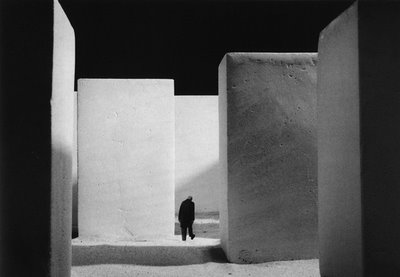
image Gilbert Garcin
Here's the transcript from the Bradblog RFK interview from a couple of days back. Its not news if you actually follow our collapse, but its worthy read.
Recently, Robert F. Kennedy Jr. , wrote the article: "Was the
2004 Election Stolen " where he examined the election fraud in Ohio that took place during the last Presidential Election. He also has written a book "Crimes Against Nature: How George W. Bush & His Corporate Pals Are Plundering the Country and Hijacking our Democracy". Mr. Kennedy along with Mike Papantonio have filed a "qui tam" lawsuit [6] against some of the voting machines companies, in an effort to save our Democracy.
I've long had a deep respect for Robert F. Kennedy for his dedicated work as an environmental advocate. Tom and I ['Bradblog'] enjoyed interviewing him and were moved by his passion and dedication to our country and our Democracy. We spoke to him via phone at his office at Pace University's Environmental Litigation Clinic in White Plains, New York, which he founded, about the election of 2004. This was an experience to remember...
BRAD BLOG: In your book, "Crimes Against Nature," you said that Bush won the 2004 election because of an information deficit caused by a breakdown in our national media. You go on to say that "Bush was re-elected because of the negligence of-and deliberate deception by-the American press." Your recent article in "Rolling Stone" seems to suggest that your opinion has changed, focusing more on the fraud and deception in Ohio with the computerized voting machines. What was the most important thing that made you suspect fraud and decide to investigate the 2004 election?
ROBERT F. KENNEDY JR.: Well, my opinion hasn't changed, that the press has been negligent, and that the large amount of support for the President, and for the people that did vote for the President, that large numbers of them would not have done so, had they known the truth about his policies, and his record. You say my opinion changed, but it hasn't changed.
You know I've known this for many years, because of my anecdotal experience. I give about 40 speeches a year, in red states to Republican audiences, and I get the same enthusiastic responses from those audiences as I get from Liberal college audiences. The only difference is, is that the Republicans often say to me, "How come we've never heard this before?" I made the conclusion many years ago that there's not a huge values difference between Red State Republicans and Blue State Democrats. The distinction is really informational. 80% of Republicans are just Democrats who don't know what's going on. And my anecdotal conclusion was confirmed by a survey done immediately after the 2004 election called the PIPA [7] report, which tested Bush supporters and Kerry supporters based upon their knowledge of current events. It found that among Bush supporters, they were widespread in its interpretations, or there were factual errors in the way that they viewed Bush's major public policy initiatives.
For example, 75% of the Republican respondents believed that Saddam Hussein bombed the World Trade Center, and 72% believed that WMD had been found in Iraq. And most of them believed that the war in Iraq had strong support among Iraq's Muslim neighbors and our traditional allies in Europe, which of course is wrong. The Democrats as a whole had a much more accurate view of those events. And then PIPA [8] went back twice to these same people. The first time it went back to the people that had these misinterpretations, and asked them where they were getting their news, and invariably they said talk radio and FOX news. And PIPA went back a third time, and made inquiries about their fundamental values, and it did start with a string of hypotheticals:
"What if there were no weapons of mass destruction in Iraq? What if Saddam Hussein had nothing to do with bombing the World Trade Center?
What
if the U.S. Invasion of Iraq had little support among Iraq's Muslim neighbors and was largely opposed by Iraq's Muslim neighbors, and by our troops and allies in Europe? Should we have still gone in?" And roughly 80% of Dem and 80% of Rep said the same thing, "We should not." And so the values were the same. It was the facts, the information, it was the access to information that was different.
BB: Are you then adding a layer of suspicion about the direct manipulation and fraudulent counting through computerized voting?
RFK JR.: That also happened, that was another factor. Our democracy is broken. Our democracy is broken because of our campaign finance system, which is just a system of legalized bribery, which has allowed corporations and the very wealthy to control the electoral results. Let me go back and say our electoral system is broken for three reasons, in three large
respects: The first is our campaign finance system, which is a system of legalized bribery, and which has allowed corporations and the very rich to control the results of our electoral process. Number two is the failure of the American press and that is also a function and result of corporate control, as I showed in my book. Number three is the election system itself, which is broken. We've privatized it and allowed four large corporations to count our votes on machines that don't work.
But also the Republican party has inculcated a culture of corruption.
The Republican party has adopted a strategy of denying votes to blacks and other minorities, and to other people more traditionally Democratic, suppressing Democratic vote and fraudulently expanding Republican vote.
And
this is happening all over the country. I would urge you to read Greg Palast's latest book, Armed Madhouse [9]. He does for the national elections what I did for the Ohio election, which is to synthesize the information that's out there into a readable document, in which he shows exactly how this election was stolen-not just in Ohio but in many other states as well.
BB: Have any of your expert witnesses or anyone referred to some of the stringent requirements in the gaming industry which uses computerized slot machines, poker machines and so forth involving the levels of certification and disclosure of the security requirements of its vendors?
RFK JR.: Well, you see this was just another corporate boondoggle that gave the most venal mendacious corporations charge of our most sacred public trust, which is the right to vote. These corporations were making hundreds of millions of dollars. The machines, as it turns out, were manufactured by wireless companies and were just a cheap piece of junk that cost less than $100 to manufacture, and they were selling them for $2400 apiece. And they were using Jack Abramoff and other corrupt lobbyists to persuade federal officials to pass the federal act to appropriate the money and then to persuade state and local officials to purchase the defective machines.
BB: Jack Abramoff was involved in this?
RFK JR.: Oh yes. Jack Abramoff, and Bob Ney [10](R-Oh), the principle figure in the Abramoff scandal and he's the author of the Help America Vote Act (HAVA). And Diebold contributed millions of dollars to these guys, including hundreds of thousands of dollars to Abramoff to lobby on behalf of HAVA, and to lobby states like New York and the other states, to adopt the Diebold machines.
BB: So HAVA was "created specifically to disenfranchise voters and verfication"?
RFK JR.: HAVA was written specifically to require the states to buy Diebold machines. I mean one company basically had control of the whole legislative process. That's why HAVA has a provision in it that discourages vote verification by paper ballots. Both Republicans and Democrats tried to reform the HAVA, saying of course we should have paper verification of the vote. Paper verification would allow you to go in, make your vote on the electronic machine, and you get a receipt that is a copy of who you voted for and you are allowed to examine that receipt. You deposit it in a locked box in the voting area. That way, if there's ever any question, if you need to count, you can count the papers, and see if it compares to what the machine says.
But Bob Ney fought tooth and nail against that provision because Diebold made a machine that does not provide a paper ballot. And he went so far, because Diebold contributed a million dollars to an organization that purportedly protects the rights of blind people. And in exchange for that, that organization got one of its officers to testify on Capitol Hill at the HAVA hearings, that blind people in America did not want paper ballots - voter verified ballots - because it would deprive someone of the right to vote secretly. Now the other organizations that support handicapped rights and rights of the blind, do not take that position. This was a position that that organization adopted after accepting a million dollars from Diebold.
The whole operation was corrupt and now Bob Ney is going to jail for it.
BB: Also, speaking of those guys, election officials in several states, most notably Ken Blackwell in Ohio and Bruce McPherson here in the state of California, appear to be be deliberately flaunting established law and procedures as well as direct court orders, and they seem to be just "getting away with it". How can that be?
RFK JR.: Well, again, it's because of the failure of the American press.
This is the most important issue in American Democracy and the press isn't covering it. So the politicians who want to fix the elections, and who want these fraudulent machines, can get away with it, don't take a position because it gets no traction in the press.
BB: But then why didn't people like Kerry want to contest the results?
RFK JR.: You'd have to ask Kerry.
BB: Why hasn't the DNC done anything about this?
RFK JR.: You'd have to ask the DNC.
BB: We watched Howard Dean on television having a hack demonstrated to him by Bev Harris [11], and he doesn't seem to say anything... I guess we'll have to ask them! But there seems to have been a pattern here in the leadership of the Democratic Party....What I was getting to in those questions was not for you to interpret the actions of the those in the DNC and so forth, but there seems to be a pattern in the leadership of the Dem Party that shies away from direct conflict in this....
RFK JR.: The Democratic leadership on this issue has been abysmal.
And
particularly since this is a civil rights issue and it's a racial issue.
The
machines themselves are kind of a distraction because the machines are recent innovations. The Republican Party, the Republican National Committee, has been using, old-fashioned, Jim Crow, apartheid-type maneuvers to steal the last two national elections.
BB: Like in Georgia, who were trying to establish the Poll Tax again...
RFK JR.: And this has been happening all over the country. If you look at who's being denied the right to vote, on absentee ballots, on provisional ballots, it's Hispanics, it's Blacks and it's Native Americans, and the Democratic Party ought to be touting this as the biggest civil rights issue of our time. But they are ignoring it, and that really is shocking. It's shocking that the Republicans are not up in arms about this too, because this should not be a partisan issue. This is a fundamental basis of our American value system, which is representative Democracy. For a party that claims to speak for "American Values" to ignore the fact that other members of the party, that the leadership of the party is involved in an active national campaign to stop black people from voting, and to steal elections, shows the moral bankruptcy of everybody in that party!
Why aren't Republicans standing up and speaking on this issue? Why isn't Republican leadership standing up and speaking on this issue?
BB: California just recently went to Diebold machines, all over the state. If California "goes" Republican, do you think we will be able to say, ok, there's no doubt anymore?
RFK JR.: Listen: all I can say is that the Diebold machines are among the worst. They break down, they are easily hacked, Diebold uses fraudulent misrepresentations to sell the machines, and they should not be part of our voting system.
BB: Are there any plans on a national or state level to contest suspicious results this time around?
RFK JR.: They make it very difficult to contest crooked elections.
Nebraska is one of several states that have now passed laws, and I believe Florida is one of those states, that prohibit counting paper ballots in votes that were originally counted by machines. The only way that you can count votes is the original way in which they were counted. And so, of course, that makes it easy to fix any election and make sure that nobody has the right to challenge it.
Many other states, including Ohio, have made it impossible for anybody to challenge an election, even if it was obviously fixed. And these kinds of initiatives are happening all over the country. Why would any state legislature vote for such a rule unless they were Republicans who felt that elections would be fixed in their favor? Why would any American vote for such a rule? It is completely anti-American and un-American. We should be encouraging Americans to vote and encouraging EVERY American to cast a vote and to make sure that every vote is counted. And both parties should be working toward that.
But instead you have a Republican party that is trying to suppress votes and trying to defraud the public. And you have a Democratic party that is like the deer in headlights. And the Democrats are never going to win another election if they don't fix this issue because they are starting out every election with a 3 million vote deficit, and those are mainly the black voters in this country and who no longer have their votes counted.
And you know, this may sound shrill, but look at the facts. And I challenge anyone who says that this is shrill and inaccurate to read Greg Palast's book, to read my article, to look at the facts, because the facts are infallible.
BB: Do you think we are going to need a reaction like they are having currently in Mexico?
RFK JR.: Well, I wish the Democratic Party had the cojones that the Mexican opposition party has! They're saying "We're not gonna stand for our elections being stolen anymore!" It's great for these (our) political leaders to stand up and say "I will gracefully concede" but what does that mean for the rest of us? We are getting stuck with these governments that are absolutely running our country into the ground.
BB: You said in your recent interview with Charlie Rose, that this is the worst Presidency we've ever had, and they've ruined our reputation in the world. So if you had your ideal President, what kind of things would he or she need to do to restore our credibility?
RFK JR.: Well the first thing we need to do is to restore American Democracy.
Number One: Fix the campaign finance system to get corporate money out of the electoral process. Corporations are a great thing for our country.
They drive our economy but they should NOT be running our government because they don't want the same thing for America that Americans want.
Corporations
don't want democracy, they want free markets, they want profits, and oftentimes the easiest path to profits is to use the campaign finance system to get their hooks into a public official and to use that public official to dismantle the marketplace to give them monopoly control and a competitive edge and to privatize the commons-to steal our air, our water, or our public treasury, and liquidate it for private profits.
Number Two: We have to fix the press: restore journalistic ethics in this country, and that is by bringing back the fairness doctrine and strengthening the FCC. The Fairness Doctrine was abolished by Ronald Reagan in 1988, and it recognized that the airwaves belong to the public; that the broadcasters can be licensed to use them to make a profit, but they use them with the proviso that their primary obligation is to advance democracy and promote the public interest. They have to inform the public because a democracy cannot survive an uninformed public. As Thomas Jefferson said, "An uninformed public will trade a hundred years of hard-fought civil rights for a half an hour of welfare." And they will follow the first demagogue or religious fanatic that comes along and offers them a $300 tax break.
Number Three: We have to fix our electoral system so that every vote is counted. Those are the first three things that any President should do, Republican or Democrat, to restore American Democracy.
BB: Now all these state laws that are being put in place could be trumped by Congress...
RFK JR.: Of course, we should have a federal law that creates federal standards for elections. All federal elections have to be verified by paper ballots. Election officials, whose job is to ensure the integrity of federal elections, cannot simultaneously serve as campaign managers or candidates who are participating in that contest. Many states already have that rule, but Florida and Ohio do not. It's a formula for corruption!
BB: In summary, how optimistic or pessimistic are you about our ability to get our country back?
RFK JR.: Well, you know, my attitude is that I don't try to predict the future, I can only say that those of us who care about this country have to keep fighting, and whether you think you're gonna win or lose, you gotta just keep slugging and you gotta be ready to die with your boots on, because that's what our forefathers did, they started a revolution, and they put their fortunes and their lives at stake. And we need to summon the same kind of courage from our generation, and demand that kind of courage from our leadership.
BB: And we have to get that message out to the Democratic leadership as well.
RFK JR.: And that's what you guys are doing....
 Over at BLDGBLOG today there is a great read.
From today's San Francisco Chronicle: "'These are some of the largest sand waves in the world,' said Patrick Barnard, a coastal geologist with the Santa Cruz office of the U.S. Geological Survey. 'They're certainly in the upper 10 percent ....Unfortunately – or perhaps more interestingly – they're underwater, lining the bottom of San Francisco Bay like tectonic corrugation:

Really want an excellent critique of US Media and the lack of humanity that TV instills during times of crisis (or any other for that matter)?Then watch this scathing rebuke from Jon Stewart at Truthdig.
"We can Understand our political and social life simply by looking around us. The job is not to be intellectual but to be INTELLIGENT – to our best talents. We need to seek a passion for the literal actuality of life, not an abstraction of individualism or the current enterprise built upon irony, lies, and the selfish capital of fashion.
I’m increasingly concerned with the notion of survival – my beliefs, my preferences and my prejudices and what these mean for an artist. Who is the moral personality behind the work? Do I have the ability to be virtuous in the face an ideology of debasement or what Larsen calls simplification? Can I understand beauty and justice? “
In my previous post I posited this series of observations and questions as a reference to Lionel Trillings fabulous introduction for Homage to Catalonia and George Orwell himself. The post was a direct reference to that as I applied these thoughts from Trilling to myself as an artist in response (of sorts) to the week’s art blog euphoria surrounding these posts by Deborah Fisher, Non Prophet Art, and Speaking of Ashes. Eric Larsen, author of A Nation Gone Blind , caught on to Deborah’s post and ran with it on his own website. The result was a conflation of my intention with the Trilling piece (and I think Ashes response to it) but thus is the nature of a discussion that gets caught chasing its own tail, out of sheer excitement for the subject and the personalities behind the discussion. If you have ever tried to have a political debate after a bottle of Jameson you know of which I speak.
I’m continuing this discussion, perhaps on my own (which is fine), because I am pre-occupied by the state of things, or at my perception of the state of things. I am also trudging forward not only in response to Larsen but because of some thread comments by The Art Soldier and Dilettante Ventures from the previously mentioned post by Deborah Fisher.
Art Soldier (referencing Eric Larsen on art):
Yet, while making your appeal for an art-art that is opposed to an art that refers to non-art (i.e., socio-political conditions), you fail to explain what makes your "art-art" the product of someone "striving for and implementing the good and just." But you don't have to, as we've seen this line of reasoning before. Its logic is particularly Modernist (having originated with the philosophy of Kant), and argues for the inherent virtue of an autonomous art separated from any reference outside of itself. It's the very justification used for establishing a 'high-art' that is exclusive and elitist. So the question is not "what is the social role of people?", but what kind of art "implements the good and the just?" This officially brings us right back to where we started -- the moral dilemma of art making -- and so far you haven't demonstrated why art-art is any more desirable than an aesthetic that engages with a lived experience outside of itself.
Dilettante Ventures:
A few problems with Berman's Twilight of American Culture (which has popped up a couple of times in comments): His "great books" prescription is a bit puritanical. Funny how his argument reeks of indie rock hipsterism - if everyone knows about it, it must suck. He plays pretty loosely with anecdotal evidence of the decline of American culture. Jay Leno's show isn't exactly "evidence" by any reasonable meaning of the term.
He cites Lyotard favorably, and then decries the "nihilism" of postmodernism. Many would consider Lyotard a "postmodern" philosopher. The problem here is that Berman doesn't really get specific about who he's implicating and which "postmodernism" he's talking about. He seems to collapse identity politics, political "correctness," and postmodernism into one big relativist soup.
This commentary is the thing I love most about blogging and has led me to re-examine the book The Twilight of American Culture by Morris Berman as I have not yet read anything by Eric Larsen except his commentary on these various posts. The Twilight of American Culture (in addition to the thoughts by Trilling) is my stepping off point for a series of posts under the title, "Alien Intelligence". I’ll begin however with a comment by Tyler Green in an interview conducted a couple weeks back which in actuality may be what brought me to the broader discussion in the first place.
Interview by Will Lager of mnartists.org
Tyler Green in response to this question:
What is the single non-art-world factor that is the greatest influence on art made today? (For instance, environmentalism, animal rights, worldwide feminism, the spread of digital technology?
TG:
This is a big and excellent question. Degeneration, particularly of societies, cultures, and political systems. Regardless of whether I’m in New York, LA or in between, I see artists making art about things falling apart. Look at last year’s top news stories: Iraq, Katrina, the London bombing, the Indian Ocean tsunami, the BTK serial killer, the continuing struggles of the Bush presidency, even the death of Terri Schiavo. They’re all about degeneration.I’m surprised that no contemporary art curator has seized on this and created a big group show about it. It could be a great example of an artist-driven show that mixes contemporary art with contemporary life.
Degeneration and collapse is after all what we are all talking about. To what degree is it happening? How do I adjust to this conclusion of disintegration? What strategies to employ for the sake of changing direction(s) – if that is even a possibility or desire. At the center of this is “the moral dilemma of art making” – as noted by The Art Soldier above. You can assume that I do not separate artist from citizen throughout this discussion but that I do believe artists have the responsibility of being leaders in their own right.
I’ll begin with some observations by various people that Morris Berman uses to discuss the idea of collapse and the degeneration of a society and its political aims of democracy or civilization at large.
From Berman himself:
The concept of decline often involves organic metaphors – notions of birth, maturity, and senescence. This way of viewing civilization goes back to the 18th century (Giambattista Vico) and perhaps even to the Ancient Greeks, but it came into common currency in the 19th century through the writings of the German Idealist School of philosophy. Hegel, for example, saw history as a kind of spiritual journey, in which Geist moved around the globe, generating the Renaissance in 15th Century Florence, and sowing the seeds of decay when it subsequently departed.
(Note: I’d like to argue that we are in a Neo-Hegelian moment and that perhaps the 19th century actually began with the French Revolution – which Berman himself alludes to in the book. I’ll look at Neo-Hegelianism in a subsequent post)
From Berman to Oswald Spengler who observes:
Civilization was organized around a central ideal, or some of what Platonic Idea, and that the process of civilization involved a stage of aging, during which the Idea hardened into pure form. This process of formalism or as he called it “classicism” was happening to the 20th century West and it would be on the Western agenda for the next few centuries.
Then Joseph Tainter:
It’s important to note though, that civilizations are anomalies and the statist configuration of hierarchy-specialization-bureaucracy, is little more than 6 thousand years old. Constantly reinforced and legitimized. It requires an expanding materials base and a constant mobilization of resources, and the trend is always higher levels of complexity. There is the processing of greater quantities of information and energy, the formation of larger settlements, increasing class differentiation and stratification, and the development of more complex technology. Collapse, which involves a progressive weakening of the political and administrative center, is the reversal of all this, and a recurrent feature of human societies. As the center weakens there is no longer an “umbrella” to guarantee safety. The strong savage the week, and there is no higher goal than survival. Literacy may be lost entirely, or decline so dramatically that a dark age is inevitable.
(FEMA, Homeland Security, Bush Administration)
Berman goes from there stating:
“Economic decline has a spiritual component which shows up as apathy and meaninglessness -Emilie Durkeim’s “anomie”. This lurks behind Spangler’s classicism. In the classicist phase, culture no longer believes in itself so it typically undertakes phony or misguided wars (Vietnam/Iraq) or promotes its symbols or slogans (Plan for Victory) all the more. As the organizational costs rise, yielding increasingly smaller benefits, so does the formalism, the pomp and circumstance.”
The conclusion is that there are 4 basic tenets of collapse:
1. Accelerating social and economic inequality
2. Declining marginal returns with regard to investment in organizational solutions to socioeconomic problems
3. Rapidly dropping levels of literacy, critical understanding, and general intellectual awareness
4. Spiritual death – that is, Spengler’s classicism: the emptying of cultural content and the freezing (re-packaging) of it in formulas- kitsch. (fashion, Chelsea)
* Parenthetical notes are my assertions
I’ll stop here for tonight….
image: Gilbert Garcin












 Posts


