
Truck Load of Art - by Terry AllenOnce upon a time
Sometime ago back on the east coast
In New York City, to be exact
A bunch of artists and painters and
sculptors and musicians and
poets and writers and dancers
and architects
Started feeling real superior
to their ego-counter-parts
Out on the West Coast so
They all got together and decided
They would show those snotty surfer upstarts
A thing or two about the Big Apple
And they hired themselves a truck
It was a big, spanking new white-shiny
Chrome-plated cab-over
Peterbilt
With mudflaps, stereo, tv, AM & FM radio,
Leather seats and a naugahide sleeper
All fresh
With new American Flag decals and "ART ARK"
Printed on the side of the door
With solid 24 karat gold leaf type
And they filled up this truck
With the most significant piles
And influential heaps of Art Work
To ever be assembled in Modern Times,
And it sent it West to chide
Cajole, humble and humiliate the Golden Bear.
And this is the true story of that truck
A Truckload of Art
From New York City
Came rollin down the road
Yeah the driver was singing
And the sunset was pretty
But the truck turned over
And she rolled off the road
Yeah a Truckload of Art
is burning near the highway
Precious objects are scattered
All over the ground
And it's a terrible sight
If a person were to see it
But there weren't nobody around
(Yodel)
Yeah the driver went sailing
High in the sky
Landing in the gold lap of the Lord
Who smiled and then said
"Son, you're better off dead
Than haulin a truckload
full of hot avant-garde
Yes and important artwork
Was thrown burning to the ground
Tragically landing in the weeds
And the smoke could be seen
Ahhh for miles all around
Yeah but nobody knows what it means
Yes a Truckload of Art
Is burning near the highway
And it's a tough job for the highway patrol
Ahhh they'll soon see the smoke
An come runnin to poke
Then dig a deep ditch
And throw the arts in a hole
(Yodel)
Yeah a Truckload of Art
Is burning near the highway
And it's raging far-out of control
And what the critics have cheered
Is now shattered and queered
And their noble reviews
Have been stewed on the road
* Ok so this song has little to do with Miami and everything to do with the East Coast/West Coast family feud (circa the late '60's) - still fun though.
Friday, December 01, 2006
Art Ark
As we head into the fever pitches of the Miami Monolith I thought I would give a shout out to all the hard working art handlers, installers and truck drivers who will be working themselves to the bone for $20/hr. Here's a dedication to what may be a perverse fantasy for some :)

Thursday, November 30, 2006
Painting and the Lens
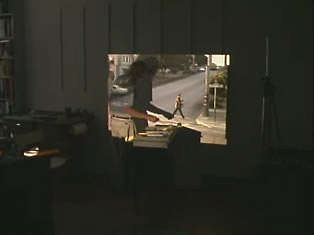
(The artist is) a provincial who finds himself somewhere between a physical reality and a metaphysical one…It’s this in-between…this frontier country between the tangible world and the intangible one — which is really the realm of the artist. - Fellini
You can take photographs of something but you never possess it because it’s too fast…there’s something very intense about the experience of sitting down and having to look at it in the way that you do in order to make a drawing of it, or to make a painting of it. - Bechtle
Alec Soth has a good post on painting and photography (my two favorite siblings) and links up to Christian Patterson's musings on Robert Bechtle (opening Dec.1). Bechtle is the best of the photo-realists because he maintians the painting part - meaning, he does not get overly possessed by the optics. He's incredibly disciplined as a craftsman but I think it is his ability in choosing the singular image that really provides resonance and his unerring eye for that California light. The stillness of the works are what makes them edgy.
Soth links also sites a great quote by Luc Tuymans as well as a question posed by Robert Herbert on how long the relationship between photography and painting can last - how much more do they have to say to each other?
It's an excellent question to pose, and seems impossible to answer - but looking at the plethora of artists using photography as a sketch book device and as a medium of fragile ownership, I'm not sure it will ever cease. The two are so linked in how we see our selves and move through and produce space. The relationship connects memory and action. For many painters the solitude afforded by a photographic source is key for their practice. As Barthes suggests, painting can feign reality without having seen it where as in photography there is a super imposition of reality and the past. It is this evidential force which bears not on the object but on time. I think this aspect of time (and light) attracts a painter to the photograph - that somehow the authentication of an object/place exceeds the representation of it - therefore allowing a space for the painter to examine this strange residual time signature by actually getting inside of it - through pigment.
image: KQED via Alec Soth
Wednesday, November 29, 2006
Color My Depression


The Guardian has news of what looks like a profound exhibition of Depression Era color photographs: Bound for Glory: America in Colour 1939-1943 at Photographers' Gallery, Great Newport St, London WC2. The slide show is beautiful and resonates more than the accustomed anguish - which is of course a political intention on the part of the photographers. Still refreshing to see.
We all are familiar with the starkness of the magnificent Walker Evans works from the same era - so this work is startling and immediatley fills a historic hole. We now have a forward for William Eggleston and William Christenberry (among others).
Gallery link here. FSA link.
Tuesday, November 28, 2006
Risk and Isolation
 God I've been waitin to use that picture for a long time! ...well as of a few minutes ago. Amazing what comes up on an image search. 1988 was a hot year though to which this picture testifies.
So speaking of "risk it" , if you haven't already read it Deborah Fisher's recent post on Risk is worth taking a serious look. She speaks to a very real shadow for any art practice - and everday practice for that matter -Risk. It is often rooted in fear and that is something plenty of us grapple with as artists. A must read if you are battling those voices again.
Not to be out done, John over at Digging Pitt blog grapples with another common ailment - isolation, albeit from the gallery/artist community perspective. He voices real concerns as the artworld expands its 'borders' and therefore opening new questions and desires about interconnectivity and access or the lack there of.
Sunday, November 26, 2006
Houston Rising
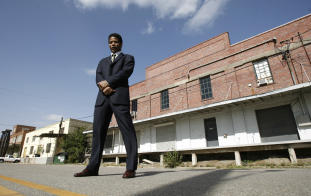
The Houston Chronicle has an informative article on the burgeoning art scene of Houston. More specifically on how artists are taking charge of their own fates by purchasing the wharehouses that have fostered the contemporary community along Commerce Street. It seems that when ground was broken for condos they got the message - in a hurry.
If you aren't familiar with Houston's scene this is a good primer as it is becoming a destination for artists to work, get recognized and most importantly -stay. Mentions go out to the Project Row Houses, the Art Guys and the ArtCrawl. Several area artists were in the last Whitney and there seems to be an increasing exhbition/financial relationship with the Los Angeles 'scene'. This looks to be another non-Chelsea choice, and that's a good thing for working artists.
image: Clement Aldridge III of the Commerce Street Arts Foundation
Monday, November 20, 2006
Art Collector - Freed
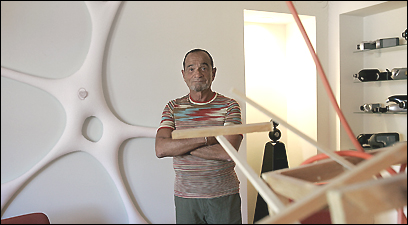 The Boston Globe has a bittersweet story about mega-collector Ken Freed. It seems that Mr. Freed has tired of the collecting game/frenzy after being one of the most active contemporary collectors in the country. He has been a big supporter and lender of many exhibitions as well. This is a pretty big loss and perhaps a cautionary tale as the artworld becomes more aligned with the business world. Read the story.
Friday, November 17, 2006
Wednesday, November 15, 2006

Sunday, October 29, 2006
Schlock and Awe
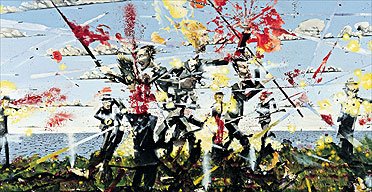
The Guardian has a review of the new Saatchi show - USA TODAY. It features some favorite Chelsea stars such as Barnaby Furnace (above), Dana Shutz, and everyone's choice debutante, Dash Snow. If there ever has been a case to ban trust fund kids from art, Snow may be it. We see the affect trust fund kids have had on the White House -of course he does seem to go to some choice parties.
After Iraq, Katrina and Abu Ghraib, what should we expect from US artists?
-the Guardian's Adrian Searle
It is nice to see that Huma Bhaba gets a positive review - she's been going at this for awhile now and seems to finally be getting some deserved recognition. The conclusion is that the show isn't a stinker but rather acceptible, expected and middle of the road. Searle ends with this:
It may not be great art, but it doesn't need to be. That's the problem. I want an art more powerful - not just loud, not just blunt. Most of art's audience already know what they think about the state of America and the war on terror. The job of artists, novelists, film-makers, musicians and playwrights demands that they go further than stating the obvious. USA Today is an expression, more than anything, of impotence.Something to mull over I'd say.
Saturday, October 28, 2006
Dim in Dallas

For what ever reason I've come this story nearly 2 months late but it still has me rattled. The Times ran a story in September about the Dallas area school teacher of 28 years who lost her job do to some ingnorant evangelical scum. The crime - the Dallas Museum of Art, rather nudes on exhibit at the museum - time honored 'pornographic' works such as these. The action by the 'concerned' parent further illustrates just how childish and repressed our population has become.
Tyler Green has the latest critique of museum director Jack Lane who in a pathetic parallel of the Mapplethorpe scandal, shrunk from his responsibity as museum director and a member of the community by not defending the artworks on display and his institution. Not so much as even an op-ed to engage the philistines about why certain works belong to the collection. Not a peep as to why historical pieces have educational merit for a civilization. Instead the artworld proves again and again how seperate it is from the culture at large and continually shows how weak it actually is. We don't need to hear the 'art is good for you' rap but why not some dead on adult discussion about how art functions? About why it is critical. That it is not a therapeutic salve for the masses or just some exotic pretty shit shoved in an expensive building to make you feel 'cultured' for an hour or so. Art has a real function so why won't these administrators clue some people in? Are they above that? Do they think average people can't handle it?
There is an enemy out there - yes, a real firebreathing meta-physical enemy that wants art to go away - our Taliban, the religious right. Trust me, it is not post-modern in nature and can not be discussed away. For now they play by the rules, manipulating the system like getting qualified teachers fired through litigious threats. In the future they may be sending in thugs to 'purify' the place. Think it is a crazy minority? 40 million people is a pretty strong power block and their off spring are getting more 'crazy' - just watch JesusCamp- that is for REAL. For now it just may be a seed but more is on the way.
Artists and institutions need to get engaged soon because they are one of the first lines of defense for a democracy, and generally the first to be persecuted.
Pod Purgatory
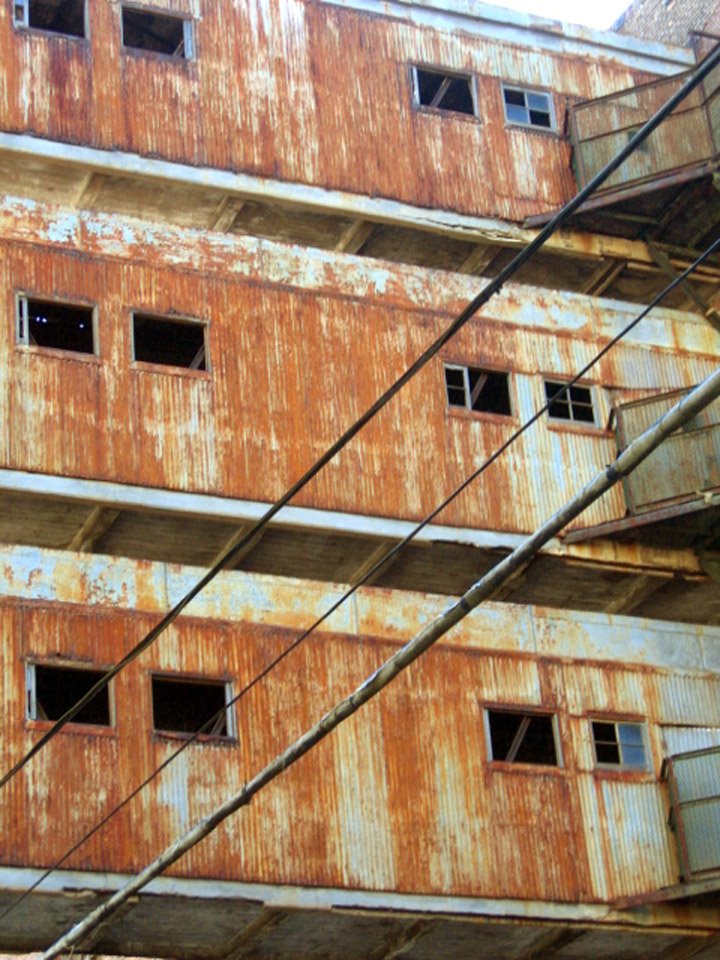
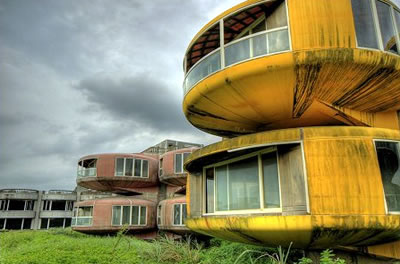 So perhaps I'm getting into the Halloween spirit here, but this tale of ghosts in a pod city is great. Via Kazys, I checked out the (:- Electro*Plankton-;) site for more details and a very weird photo set. The location is an abandoned concept resort city - San Zhi, on the northern coast of Taiwan. The project was created by a group of anonymous architects (Govt. contract) and due to unnatural deaths, the project was abandoned mid-construction. What is left is a pod purgatory for wayward souls - and perhaps a great location for Tacita Dean!
Friday, October 27, 2006
so what does a big fat swollen tick look like?
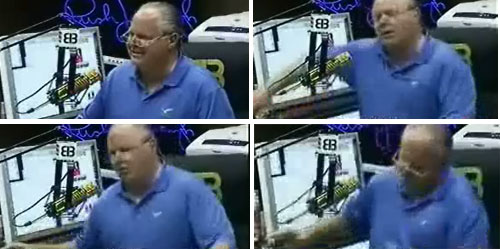 So by now I know most people have seen the footage of Rush mocking Parkinson's Disease, but in case you haven't you really should take some time to view this footage at Crooks and Liars.
This folks is the nerve center for GOP smear tactics and the heart and soul of the party. The architect behind O'Reilly, Hannity and the other monsters. This is a man personally responsible for the reality of a GOP Congress - a man who was married by Clarence Thomas and routinely lunches with his good buddy Newt Gingrich. Lee Atwater would be proud.
Thursday, October 26, 2006
Wednesday, October 25, 2006
Wicked Games
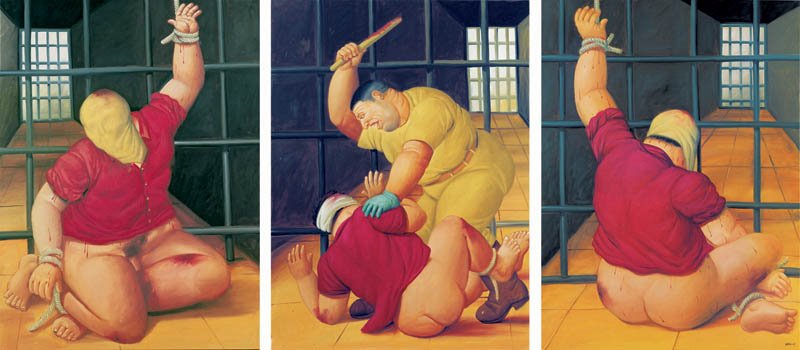
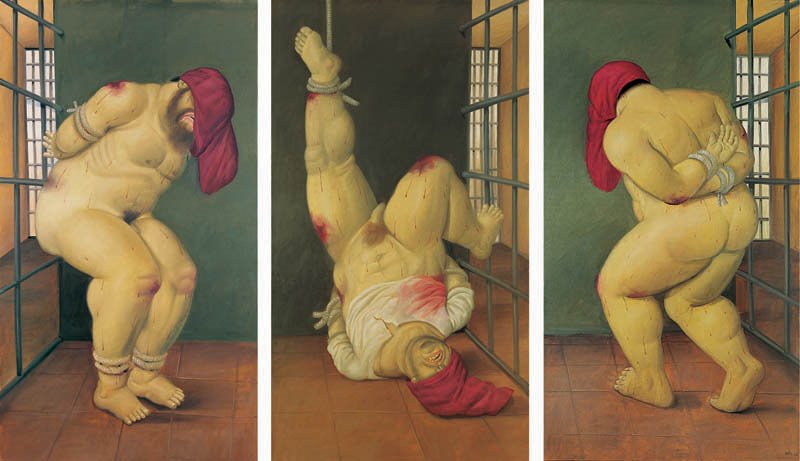
Seemingly out of left field comes some figurative art that is addressing the more sinister brutalities of today - Abu Ghraib by Botero. Yes, Botero. I confess, I associate Botero with art collectors who spend as much on their fumador and wine collections as their contemporary art collections. Yet here the Colombian born artist is addressing atrocities and pulling it off (I think) like Leon Golub. They have an intensity reminescient of Bacon and perhaps a little of Masaccio. I'm still digesting these and I'm sure scale (these are huge) plays a major part for these works. A visit to Marlboro may be necessary.
"When the 1960’s came along I was feeling split, schizophrenic. The war, what was happening to America, the brutality of the world. What kind of man was I, sitting at home, reading magazines, going into a frustrated fury about everything - and then going into my studio to adjust a red to a blue?"
- Phillip Guston, 1974. (something we should all be considering)
Botero has addressed violence in the past regarding the upheavals of Colombia so in some ways this isn't new territory for the artist but certainly for viewers less familiar with his engagements in Colombia - such as myself. It is worth noting that these works have been traveling throughout Europe but NO U.S. institution has agreed to show the paintings! That silence speaks volumes - you fill in the gaps.
My initial response (beyond historical and journalistic) was to compare this work to Jenny Holzer's last show at Cheim & Reid which focused on Gitmo. I was flinching abit as I was hoping that this was not some effort at relavancy through platform political/human rights subject matter. I detest profiteering like that in the artworld or Hollywood for that matter. I was relieved to read this:
Botero:
They are going to be donated to a museum eventually, I don’t know where. I’m not new to the principle of donating. I donated 200 of my paintings to Colombia, and I donated a whole series of paintings based upon the war in Colombia to the National Museum there. But I will donate these because I don’t feel like doing business based upon somebody else’s pain. That’s not my thing.I have no proof to the otherwise, but I'm wondering if the Cheim & Reid show was strictly for profit on the shoulders of others agony. I'm not doubting the content but wonder about the back room business ethics surrounding politically senstitive works. It is a very sticky line to walk. Despite no US venue to have a discussion on America's role in torture, these Botero works will at least be part of the public record somewhere long after the journalistic images go into hiding.
Here is the complete ART INFO Interview:
Monday, October 23, 2006
Art Attack - Moscow

I am very disturbed by the recent posting over at Mark Vallen's Art For a Change. Mark details the recent mauling of gallerist Marat Guelman over an exhibition that many New Yorkers flocked to earlier this year at White Box - Russia 2: Bad News From Russia. An excellent show of contemporary Russian art that featured the artist team - The Blue Noses, one of Russias larger exports (very nice comical guys btw). It seems that Fascists/Nationalists still are threatened by art. Some things never go out of style it seems. As bad as things are here, we have yet to sink quite to this level of barbarity. Of course that could change easily - how would we respond?
More ArtWorld Life Cycle - the Art Adviser

There are a lot of novice collectors out there who don’t realize that you can’t run through the door and make your first purchase. You have to finesse your way to that. Primary market galleries like us often have three-year waiting lists. We’re very picky. - David Zwirner
Coming on the heels of the Saltz piece (see here) it was great to see this article by the Times posted by the Digging Pitt blog. For all the artists that feel humiliation at the hands of their coveted gallerist - meet the young collector who can't even buy respect :) Very informative for those not understanding the "business". It wasn't so long ago that the art adviser was more or less derided as bench player.
Wednesday, October 18, 2006
SPAM POEM [1]

“hi Alonzo i hope this is your mailbox”
I was happy to see you the other day. I hope you are truly had like the New York.
So much so much happening all the time, lots of great opportunities.
Hip Hop superstar Sean "P.Diddy" Combs sees a colossal prospect for his company in collaboration with Goldmark inc. Sean "P.Diddy" Combs tells that it is enjoyably to deal with these guys. They as anybody else know entertainment industriousness and exactly know what is necessary for the American spectators
TAKE GDKI and you will earn from every sale of that golden disc!
And speaking of opportunities,
Is your girlfriend as tight as Fort Knox?
Deliver the ultimate weapon and youre sure to slide in!
she would lose instead
reproduction of the actual object visible at
not, even if he wanted to, emigrate -
Saturday, October 14, 2006
Have You Hugged Your Critic Today?
Never use your sales pitch on your peers – save it for the clients – Dave Hickey.
Having attended the Donald Kuspit lecture the other night (see Deborah Fisher) entitled Why Do Artists Hate Critics, I decided to add a different angle to the lecture discussion and what DF covers on her blog. I will say that I found my self interested in most of what was covered in the lecture but also felt a little bored. I guess for me I understand the historic binary of the critic and the cultural producer and the artist vs. artist mentality and was disappointed that we didn’t go beyond these things which frankly feel like a preamble to where we are today. I had hoped to get into the emerging role of artists speaking for themselves and filling some critical gaps in the contemporary landscape we find ourselves. I also wanted to get into why artists and critics are very similar animals in the end and what the critic means to the cycle of life in the artworld. Criticism seems to me to be a bit of a lonely practice not so indifferent from many studio practices. I’ve always felt some consternation as to why so many artists feel directly threatened by what ultimately is simply a larger discussion on meaning that can change and turn at any point by a myriad of varied catalysts. I can understand the raw feelings from a negative review (as if these even happen now) but ultimately these are tests to the practitioner to get out of their own skin from time to time and see how their works operate within the larger sphere of public engagement.
I was glad to find some thoughts on the role of the critic “these days” coming on the heels of this lecture. The Sept. issue of Modern Painters has a great little piece by Jerry Saltz that touches on this somewhat. It’s a great commentary on the role of the critic in a time where the market is so strong and global -frankly dictating more than most artists even comprehend. Saltz begins his respectful discussion with some of the sales pitch motifs he encounters from gallerists all the time. He cites that now the artist being exhibited is always described in terms of big name artists as if the work being viewed can not stand on its own without an associative qualifier. The current fashion is to say that this work is related to Warhol, Richter, Nauman, Kippenberger, Richard Prince, Mike Kelley or Jeff Wall (regarding emerging male artists). Or the trick is to say a famous artist “loves” this work, As in, “Well Kiki Smith really loves this work”. The reality of such assertions is that Kiki Smith probably said something along the lines of “congrats” on the show which ultimately gets spun into a celebrity endorsement. Saltz backs this up with an anecdote of such a case as told by Elizabeth Murray. The other slamdunk pitch is to say Saatchi is “interested”. I think we’ve all heard that! Or this piece is significant because Saatchi is buying it. I’ve heard this a few times as a pitch by the gallerist and the artist as well. My gut response is congrats on the sale but who cares abut the Saatchi part – it’s just as easy to view that as a negative. He buys every young artist and just for that reason – young. It’s a real estate speculation. If you own all the property you’re bound to make a profit – its basic monopoly not curatorial vision.
But back to the plight of the critic! Saltz continues with horror stories of dealers trying to hustle him and ultimately prevent him from seeing the actual art. He feels demoralized because in the current aggressive climate he is being told what to think. This should sound familiar to most artists. He continues that curators are now in the same act, pimping, pushing and plugging as if every interaction is a sales opportunity.
To look at art you need to get very, very quiet inside yourself. You must be able to hear your reactions. You can’t do this while someone is telling you what your reactions should be.So what about the market and the role of the dealer, critic and artist? At no time in the last 50 years has what an art critic written had less of an effect on the market than now.
Many have hailed this as the death of criticism and that can be true, especially of the new breed of reviewer which seems more about networking and association into a preferred clique than critical engagement with art. Saltz wisely sights that it is really about the power of the market – the market is “smart” and is moving at its own momentum so no matter what anyone writes it doesn’t have a real monetary impact on what is collected.
This can be viewed as horrible but I’m willing to wager along with Saltz that it could actually free criticism to do what it needs to do – critique, and draw conclusions for the larger art equation that needs constant stewardship and rigorous review while being outside the market. It also frees artists to do what they need to do – their work, in terms of practice but also in terms of engaging criticism. The artist and the critic need each other now because the market is so forceful that without this reciprocal relationship of the “serious”, things may very well be reduced to hyped product and redundant drivel so associated with Chelsea and London right now - which ultimately insults Art.
Monday, October 09, 2006
Berliner; Travelogue
So finally back on board here, after a long patch of travel and work. When traveling, I always hold this fantasy that I will get ahead on some reading and thus bring along several thick books. Of course I never crack these but do manage to read the airline magazine and gift guide and generally suffer through some bad film on both legs of the journey. You’ll be glad to know I held to form with my Berlin trip. X-Men and Xanax or Michel deCerteau? Who’s gonna win that one right? I had hoped to blog but I found out quickly that it was not to be done with so many late nights and jet lag. Next time perhaps because I sincerely feel I missed something in not blogging on the run. At least I “finally” got to see Devil Wears Prada as a consolation prize...wretched.
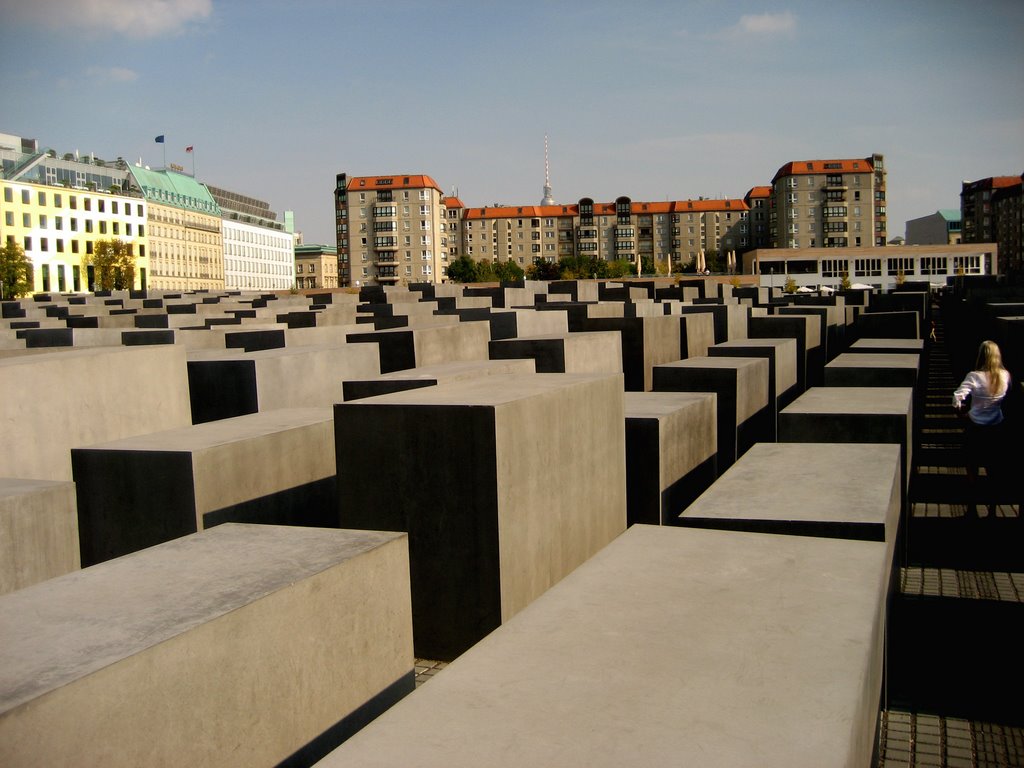
Anywho, on to Berlin. Artists should be proud in the fact that I did not go to Art Forum art fair as planned (despite a free ticket) – we all hate the fairs so it seemed more appropriate to head to the Holocaust Memorial and the Hamburger Bahnhof Museum while there. The payoff was huge. I hit the memorial around 10:00 am so the crowd was small but enough to experience some of the intended tension and mystery of the site. The sun was really cresting at this time and shot through the concrete corridors with laser precision. Wandering the lanes of constantly shifting altitude, piercing sunlight and momentary glimpses of others in the periphery was quite intense on 3 hours of sleep. Ghostly and profound, my thoughts strayed to the narrative of the atrocities and the stories of several friends who had relatives directly involved. I also couldn’t help but think of the graveyards in New Orleans as well – the above ground tombs that create labrinyths of past lives. It was a striking connection about abandonment. The memorial is Peter Eisenman’s masterpiece and a real triumph of how art/architecture can convey the human experience, even a dark chapter with integrity, abstract beauty and solitude. I know what the critics think but I found it a place of reflection.
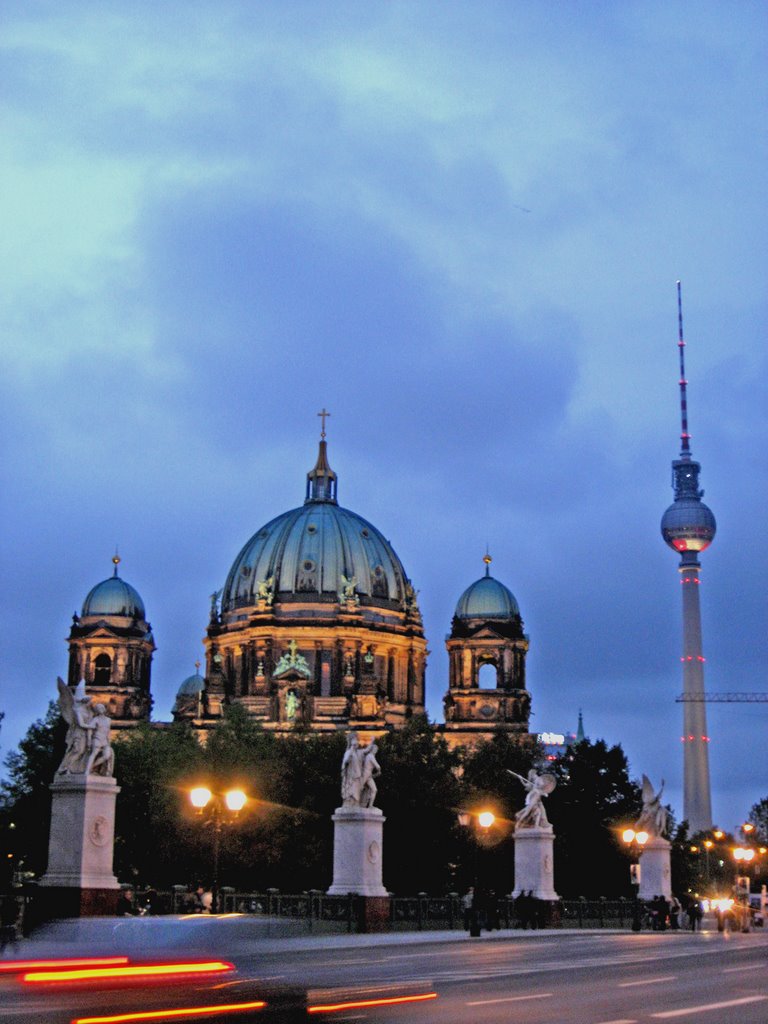
 From there I made my way to the Mitte to hit some galleries, etc. Most of the offerings were quite dull and I was disappointed but happy to have some decent coffee. While in that area I did manage to see some video works by Mika Rottenberg and Jen DeNike at Kunst Werk, the Institute for Contemporary Art. Solid works by Rottenberg and DeNike but I was a little disinterested in the Aaron Young pieces. Great venue to see video though.
Building on the video theme, I was happily impressed by the shows at the Hamburger Bahnhof which is a former train station come art museum. Spectacular space and so many good shows I had trouble getting out of there. Imagine this list at any NY Museum: Joseph Beuys, Felix Gonzalez-Torres, The Atlas Group, and the best video show I have EVER seen in one place: “Beyond Cinema: The Art of Projection Films.Videos and Installations from 1963-2005”. The works primarily came from the Flick and Kramlich Collections It was such an expertly installed show expect for perhaps what may be a mistake with the Peter Campus piece. I don’t think I have ever dedicated so much time to viewing video, nearly 2 hours on a single visit with no sleep – that should say plenty. I’d love to recap each one but it’s impossible. I’ll just say that I did get emotionally swept up with Pipilotti Rist smashing car windows with a flower. I was tweaked enough to crave each and every blow to the unsuspecting autos. Awesome.
The rest of the trip was art related work. Long conferences, etc. I did get to meet and spend time with some great people along the way. So to name drop a few: Mathilde Rosier, Lu Jie, Kay Pallister, and many more. The social side was mostly a few random bars and a fairly delinquent night at the famed Paris Bar (and later King Kong). Perhaps past its prime but I’m a tourist sucker for history (and the free flowing wine) surrounded by donated artworks (some famous) from the past 50 years was too good to pass up. At moments you get that Cold War nostalgia mixed with the 19th century French Boheme mythology. Good stuff when you’re wasted!
 So a brief taste, but Berlin seems to be a great place to be right now with tons of ex-pats from the US, France, UK, etc. -the hype may be true, Berlin is the new Center. The NY artists I met seem to be truly in love with place and want to stay for awhile. The support they are experiencing and the cost of living is too good to give up for that million dollar a month studio in Bushwick it seems. The best part is I never once was asked about or heard the word Chelsea!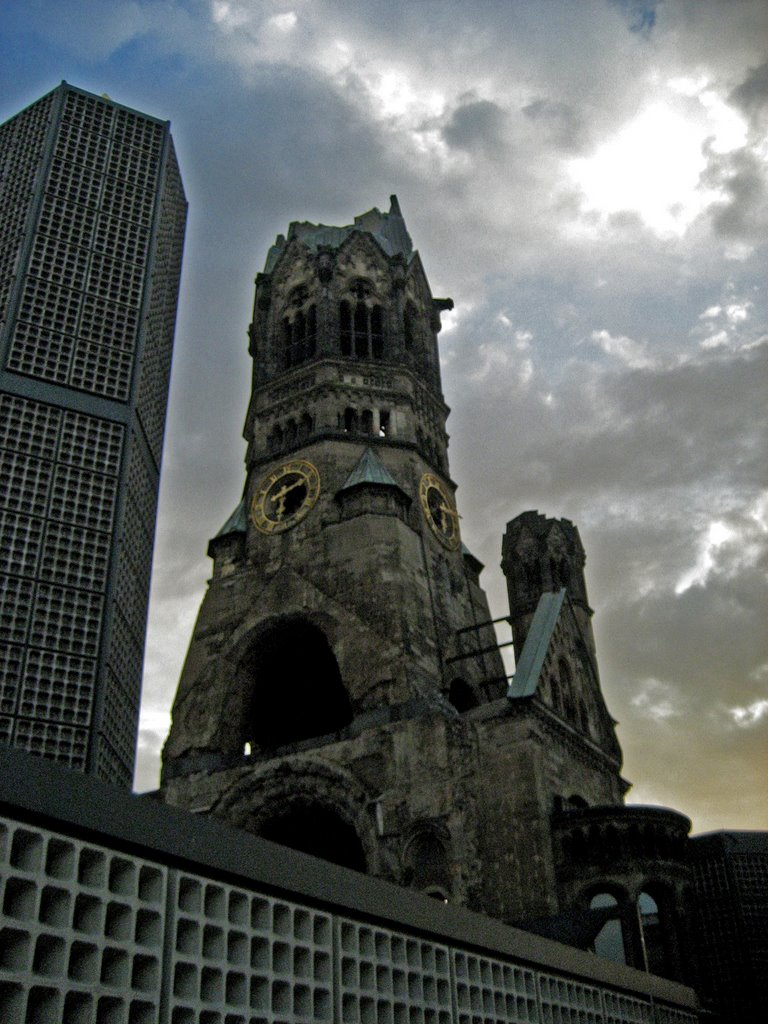
Monday, September 25, 2006

Tuesday, September 19, 2006
Hey Taxi

In case you didn't know New York's iconic taxicab will be 100 years old in 2007. To mark this centenary, the Design Trust for Public Space has launched Taxi 07, a program of public events and publications to improve cab design and the entire taxi system.
The Taxi 07 Master Plan, to be published April 2007 in partnership with the New York City Taxi & Limousine Commission (TLC), will outline the next decade of improvement priorities for New York cabs.New Yorkers (and anyone who has taken a cab) should get to know this great project and definitely do the survey. The Design Trust does great work and will certainly listen. My first suggestion would be give these cabbies some map training and provide rides home to Brooklyn once and while without the grimace!
Make your opinions heard by taking our 20-question survey at http://www.taxi07.org -- every respondent also has a chance to win exclusive tickets to the Design Trust's gala cocktail event and benefit art auction at Rafael Viñoly Architects.
The survey is up for two weeks only, until September 30th, 2006. Shape the future of the New York City taxicab; take the Taxi 07 survey at http://www.taxi07.org.
Art Fund Chatter
Hyper busy these last days but I thought this was a mildy educational piece over at the Art Newspaper -- HLB
From Editorial & Commentary:
The implications of art fund collections shown in museums
By Adrian Ellis | Posted 14 September 2006
Art funds are investment vehicles, the return on which is linked to a portfolio of works of art acquired—as opposed to the stocks, bonds, property and commodities that are the usual components of investment funds. The return to the investor is determined, on the one hand, by the buoyancy of the art market or, more specifically, the bit of it in which the fund is investing (for example, contemporary, Asian or decorative arts) and, on the other hand, by the shrewdness of the decisions made by the funds’ managers with respect to specific acquisitions. The more buoyant the art market, the less shrewd the fund managers need to be to beat other financial instruments with which they are competing for investors’ attention and money.
Art funds are a relatively new phenomenon, spawned by the financial markets’ constant search for new gizmos and by the booming art market, particularly the contemporary art market. About 12 funds have been created in the past three years, playing off the contrast between the surging art market and the flat stock market. Those that have stayed the course include The Fine Art Fund and The China Fund.
Some have missions that seek to combine the power of the market with broader aims—in the case of the Artist Pension Fund, for example, the aim is to create a stream of income for artists in their retirement by cross subsidising less successful artists from the proceeds of more successful ones. Others, such as the Ellipse Foundation and the Wonderful Fund (see p6) have a for-profit framework but a rhetoric that combines commercial and non-commercial intentions in a way that is difficult to decode and disentangle.
Given the thin, lightly regulated and opaque nature of the art market compared with, say, the market for pork bellies or oil futures, art funds are usually aimed at the more speculative and affluent investor, who can afford to take a hit if and when the market implodes. To date, and notwithstanding the hoopla with which they have been launched, and the disproportionate coverage they get in the frothier parts of the financial press, they have not been notably successful either at attracting investors or at generating the sort of returns that appeal to a hard-nosed homo economicus.
One of the more noisily launched, Boston–based Fernwood Investments’ art fund—the subject, no less, of a Harvard Business School case study on alternative investment strategies—folded in 2005, less than two years after its launch; and others have been trailed but failed to launch, unable to attract funds sufficient to generate a diversified investment portfolio.
Notwithstanding their financial marginality, art funds raise interesting dilemmas when their holdings are shown in public museums. Whether or not the collector intends it, when works of art are lent to a museum, their value is usually enhanced. The collector can then realise that value through resale of the work with the beefed-up provenance and price that its stint in the public domain accrues.
The failed Fernwood fund explicitly embraced the technique in its description of its proposed investment strategy. Bruce Taub, the fund’s founder, told BusinessWeek in 2005 that the fund planned to lend pieces to museums or important exhibitions. That way, he said, “the value of the art will be enhanced through exposure”.
There is, of course, nothing new in museums borrowing from and displaying the works of private collectors. The development of art museums’ collections throughout the world can only be understood in the context of the relationship between private collectors and their complex motives on the one hand and museum administrators’ desire to harness those motives for the pubic good on the other. Directors, administrators and curators are acutely aware of the symbiotic relationship between public access to works of art that may not otherwise be seen, studied or enjoyed, and the private interest of the collector—sometimes wholly venal, sometimes wholly altruistic, and usually a deeply conflicted mix of the two.
The considerations that apply to art funds per se are exactly the same as those applying to any other private entity lending to a public museum, whether it is UBS loaning works to MoMA and Tate Modern or the Duke of Northumberland loaning the Madonna of the Pinks to the National Gallery. The Museums Association in the United Kingdom and the Association of Art Museum Directors in America have broad guidelines on the balancing of public and private interest, and the need for transparency, and accountability in circumstances where there is the possibility of private gain. They represent a pragmatic response to the reality that the public sector is and will remain critically dependent upon the private sector and indeed that the route to donations of work is usually through loans in the first instance. And that few public museums today have acquisitions budgets that allow them to neglect this vital source of new work.
Although the relationship between art funds and public museums is in principle no different from that between other collectors or dealers and museums, museums need to approach possible loans with particular vigilance and particular sensitivity to existing guidelines. While collectors have notoriously complex motives and psychologies, art funds do not: they are there to maximise the rate of return on their holdings, subject to the rule of law. (There is not yet a specific code of ethics for this class of investment vehicles.) This suggests they will take a fairly “instrumental” view of public museums’ potential contribution to asset appreciation and, unless they can attract more investors and demonstrate solid returns over the longer term, a fairly desperate one.
The writer is a regular columnist for The Art Newspaper and a director
of AEA Consulting (www.aeaconsulting.com)
From Editorial & Commentary:
The implications of art fund collections shown in museums
By Adrian Ellis | Posted 14 September 2006
Art funds are investment vehicles, the return on which is linked to a portfolio of works of art acquired—as opposed to the stocks, bonds, property and commodities that are the usual components of investment funds. The return to the investor is determined, on the one hand, by the buoyancy of the art market or, more specifically, the bit of it in which the fund is investing (for example, contemporary, Asian or decorative arts) and, on the other hand, by the shrewdness of the decisions made by the funds’ managers with respect to specific acquisitions. The more buoyant the art market, the less shrewd the fund managers need to be to beat other financial instruments with which they are competing for investors’ attention and money.
Art funds are a relatively new phenomenon, spawned by the financial markets’ constant search for new gizmos and by the booming art market, particularly the contemporary art market. About 12 funds have been created in the past three years, playing off the contrast between the surging art market and the flat stock market. Those that have stayed the course include The Fine Art Fund and The China Fund.
Some have missions that seek to combine the power of the market with broader aims—in the case of the Artist Pension Fund, for example, the aim is to create a stream of income for artists in their retirement by cross subsidising less successful artists from the proceeds of more successful ones. Others, such as the Ellipse Foundation and the Wonderful Fund (see p6) have a for-profit framework but a rhetoric that combines commercial and non-commercial intentions in a way that is difficult to decode and disentangle.
Given the thin, lightly regulated and opaque nature of the art market compared with, say, the market for pork bellies or oil futures, art funds are usually aimed at the more speculative and affluent investor, who can afford to take a hit if and when the market implodes. To date, and notwithstanding the hoopla with which they have been launched, and the disproportionate coverage they get in the frothier parts of the financial press, they have not been notably successful either at attracting investors or at generating the sort of returns that appeal to a hard-nosed homo economicus.
One of the more noisily launched, Boston–based Fernwood Investments’ art fund—the subject, no less, of a Harvard Business School case study on alternative investment strategies—folded in 2005, less than two years after its launch; and others have been trailed but failed to launch, unable to attract funds sufficient to generate a diversified investment portfolio.
Notwithstanding their financial marginality, art funds raise interesting dilemmas when their holdings are shown in public museums. Whether or not the collector intends it, when works of art are lent to a museum, their value is usually enhanced. The collector can then realise that value through resale of the work with the beefed-up provenance and price that its stint in the public domain accrues.
The failed Fernwood fund explicitly embraced the technique in its description of its proposed investment strategy. Bruce Taub, the fund’s founder, told BusinessWeek in 2005 that the fund planned to lend pieces to museums or important exhibitions. That way, he said, “the value of the art will be enhanced through exposure”.
There is, of course, nothing new in museums borrowing from and displaying the works of private collectors. The development of art museums’ collections throughout the world can only be understood in the context of the relationship between private collectors and their complex motives on the one hand and museum administrators’ desire to harness those motives for the pubic good on the other. Directors, administrators and curators are acutely aware of the symbiotic relationship between public access to works of art that may not otherwise be seen, studied or enjoyed, and the private interest of the collector—sometimes wholly venal, sometimes wholly altruistic, and usually a deeply conflicted mix of the two.
The considerations that apply to art funds per se are exactly the same as those applying to any other private entity lending to a public museum, whether it is UBS loaning works to MoMA and Tate Modern or the Duke of Northumberland loaning the Madonna of the Pinks to the National Gallery. The Museums Association in the United Kingdom and the Association of Art Museum Directors in America have broad guidelines on the balancing of public and private interest, and the need for transparency, and accountability in circumstances where there is the possibility of private gain. They represent a pragmatic response to the reality that the public sector is and will remain critically dependent upon the private sector and indeed that the route to donations of work is usually through loans in the first instance. And that few public museums today have acquisitions budgets that allow them to neglect this vital source of new work.
Although the relationship between art funds and public museums is in principle no different from that between other collectors or dealers and museums, museums need to approach possible loans with particular vigilance and particular sensitivity to existing guidelines. While collectors have notoriously complex motives and psychologies, art funds do not: they are there to maximise the rate of return on their holdings, subject to the rule of law. (There is not yet a specific code of ethics for this class of investment vehicles.) This suggests they will take a fairly “instrumental” view of public museums’ potential contribution to asset appreciation and, unless they can attract more investors and demonstrate solid returns over the longer term, a fairly desperate one.
The writer is a regular columnist for The Art Newspaper and a director
of AEA Consulting (www.aeaconsulting.com)
Tuesday, September 12, 2006
post-thought
So I'm still finding myself somewhat washed out today. Distracted, thinking back still and wondering where "this" is all heading. Watching the lights last night with a friend of mine we couldn't help but wonder aloud and slander basically everyone in leadership - friend or foe - for being such incompetent, selfish and hateful men. So I thought I would link to this excellent commentary by Keith Olbermann. Also John Schaefer of NPR had an interesting program yesterday regarding the state of the arts and the response to disasters such as 9/11 and Hurricane Katrina. Here's the discussion at Soundcheck. This is obviously a music slant but it applies to the visual arts.
Monday, September 11, 2006

Thursday, September 07, 2006
Grand Opening :ChelseaMart
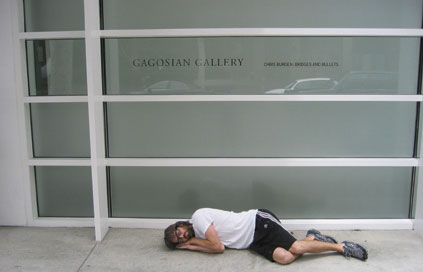
If you are in NYC you know that tonight is the deluge . Chelsea is open and ready for business! 4500 artists are currently "supported" by galleries in that special commerce zone we know and love. I read that we have 117 openings this week to choose from. For the willing, I'll let ArtCal do the guiding - check out the buffet. Bring comfortable shoes and leave your discerning taste at home.
image: Kent Parker, 2003
Tuesday, September 05, 2006
Adventures with Form in Space
 I saw this interesting show posted over at Gravestmor. To quote:
“Adventures with Form in Space”is the theme of this year’s Balnaves Sculpture Project at the AGNSW. And it is a particularly good year.
Hot on the heels of NASA’s announcement that Dark Matter exists, comes Nike Savvas’s accurately title installation “Atomic: full of love, full of wonder”. It is an amazing room of freeze framed atoms that apart from some maverick dad letting his daughter play and tug at the sculpture, leaves the assembled viewers quietly agog. Suspended polystyrene balls held in place on nylon wire fill the room in a rough grid, running though the spectrum from reds to blues up the room with a few rogue orange balls escaping their hue, bubbling up into the cooler tones.
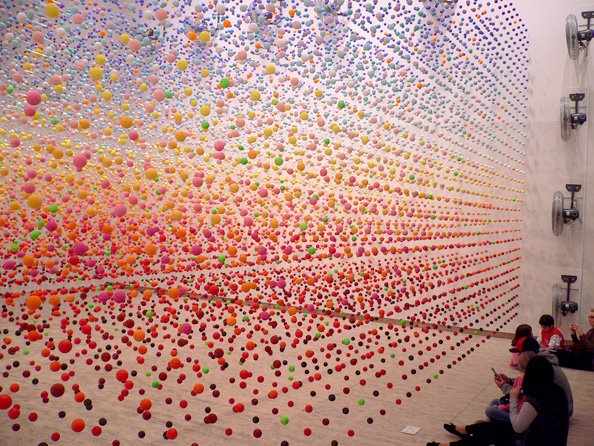 This work touches on what Steven Larose has been sorting through with his new works on paper series. Also this post on the "end" of string theory, by Bill Gusky comes to mind as it references a new concept, "braids". Bill links to this article: You are made of space-time. The braid theory, or rather "Loop Quantum Gravity", is in its early stages but may be able to merge general relativity and quantum mechanics into a single consistent theory. As Bill wonders - will this change our view of ourselves? How will it manifest in the art we make? I wonder if it will further underscore the growing divide between political will and scientific discovery? Perhaps a growing role for artists is to fill that gap in some way.
Wednesday, August 30, 2006
Polidori and Katrina
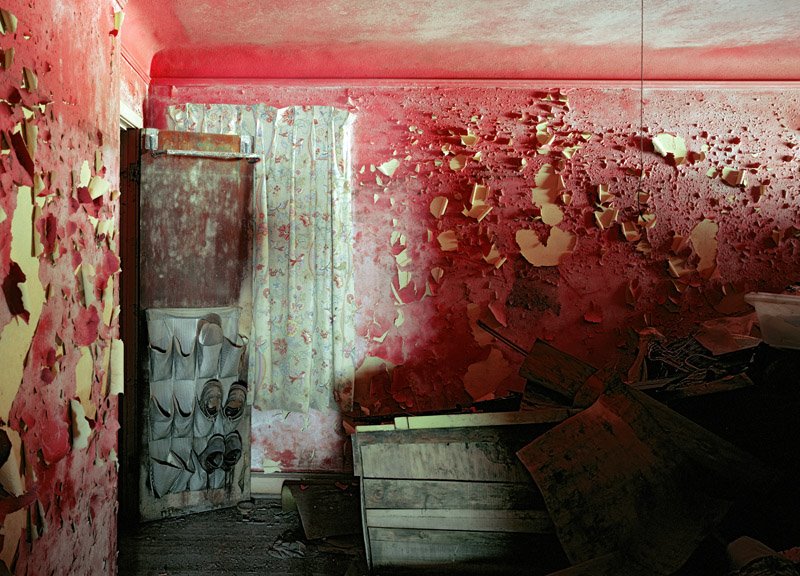
As Katrina has been on my mind alot for the last year and obviously this week, it was not such a surprise to learn that Robert Polidori has a new series of New Orleans centered on the disaster. The pictures are due for exhibition this fall at the MET. There is a short interview with the photographer at Art:INFO. Several knockout thumbnails are included of homes decomposing in the aftermath of the storm throughout this past year. They are beautiful, horrifying and fascinating works. Poverty and decay seem to have a way of preserving the strangness of the "past". Polidori has some interesting insights into artmaking and photography.
Here's a sample of the interview:
Something that has always struck me about the high level of detail that you’re talking about in your work is that it allows you to make your pictures more telling in psychological terms.image: Robert Polidori
Yes, I think so. When images are soft, they just remain evocative, or in your imagination. You get a mood, and it remains on the emotional level. The viewer has to put more of him or herself into it. When there is more detail, it’s like that old expression: There’s no fiction stranger than reality. Reality will compose the most extreme paradoxes and contradictions and adjacencies, which can’t be understood.
So detail gives you more mental work to do. There are more things to look at, which suggest more and more questions. All that mood is still there anyway, so it’s like the double-punch effect. It’s a question of keeping the mind occupied while the emotions are being silently manipulated on the back burner. I just think it makes for a richer experience. And it has the added value of being a more accurate historical record. So you have something for everybody.
And how does that relate to the pictorial sophistication of your images?
I’m not one of these artists who’s making art about the processes or the rules of art-making. I’m not interested in that. I think that that’s been gone through, and I think that it’s one dimensional. It’s not about art-making. However, there are aesthetic principals there, pictorially speaking. The grammar of my pictorialism comes from pre-Renaissance and Renaissance perspective, because all of that stuff is built into modern lenses. So that is assumed in the technology that I use.
What would you say was your basic reason for taking photographs?
I don’t take photographs because I love doing it (though I don’t hate it). Some photographers are in love with the process of taking a picture. Psychologically, I’m more interested in the situations that taking the picture puts me through, and what it forces me to witness. I really do it because I want that picture. It’s like I’m collecting evidence, like a detective looking to solve a case. I don’t mean that literally, but I use it as a simile. It’s a thing about phenomena and asking questions. And answering some, but not answering all of them.
Yes, I see that. It’s like you were saying earlier about reality’s paradoxes. It seems to me that this is what makes these New Orleans pictures so poignant. Each image presents the evidence of someone’s neat and ordered life that’s just been turned upside down.
Yes, it’s imploded. I’m interested in interiors, and I have been for a long time, simply because they’re indices of individuals’ personal values. They tell you a lot about the individual. Like I’ve said before, to me interiors are both metaphors and catalysts for states of being. You can take a portrait of somebody, and you might have a feeling looking at their face, but you know less things about them by looking at their face than you do when you look at the way that they compose their own interior space. What interests me are their values.
Tuesday, August 29, 2006
file under ROCK: D.jr
 J, Murph and Lou descended last night like a fury. Mascis is a white haired wizard, a true guitar God! Damn it was amazing! For the old geezers "Forget the Swan" was definitely the highlight.
Brilliant.
8-29-05
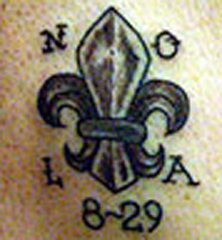
*Please note. Tonight is Spike Lee's When The Levees Broke on HBO. I saw it last week and it is frankly his greatest artistic achievement, heroic actually. For every American, a stark reminder of our national shame and our fragile nature. Warning, this is real documentary so be prepared to get upset. Think of these people when you vote in November and don't forget those in the Gulf Coast.
Monday, August 28, 2006
Those "dirty" words

There's great little piece at the Philadelphia Enquirer on the use of dirty words and the wild variations from culture to culture. Its seems, universally that people like to use sexual words to express their anger or agression towards another. It seems that most taboo expression is rooted in spiritual superstition and elaborate rules about mixing sex and speech. For Americans, FUCK is still the supreme being as if we needed reminding. What I didn't know is that word is 1000 years old and pretty much the king of the hill for the last 400 years. It has nothing to do with "for unlawful carnal knowledge"! The sad part is, that experts are concerned that its over usage may deem it mute. Wouldn't that be horrible!
Friday, August 18, 2006
Computer World
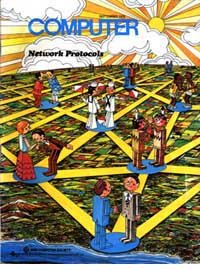
Chris Jagers just turned me on to the Computer History Museum
and its Internet History exhibition. The drawings / sketches for the preliminary designs of the "Arpanet" are amazing and wildly simple when compared to what we have come to know and use as the internet today. In addition there are some cool code thumbnails and of course the always super "sci-ficomputer systems of the 1960's and 1970's. You really have to go through each decade to see how such a simple network idea can blossom. Artist's should really look closely at this as it certainly relates to how ideas develop "outward" The show is truly quite fascinating stuff when you consider the creativity involved. I'm amazed at the nostalgia I have for the machines too- most of which I have never even used!
This is another excellent compendium to these earlier posts: 15 Megs of Fame and the Pew Blogger Survey.
image: Computer Magazine 1979
Virgin Alert
 Yes Mary has arrived once again and her chosen medium? it's not wood, it's not a mushroom, -It's a chocolate dripping!
FOUNTAIN VALLEY, California (AP) -- Workers at a chocolate company have discovered a 2-inch-tall (5-centimeter-tall) column of chocolate drippings
Just when you start to loose faith in the world....
here's the link at CNN for the full disclosure.
Sunday, August 13, 2006

Thursday, August 10, 2006
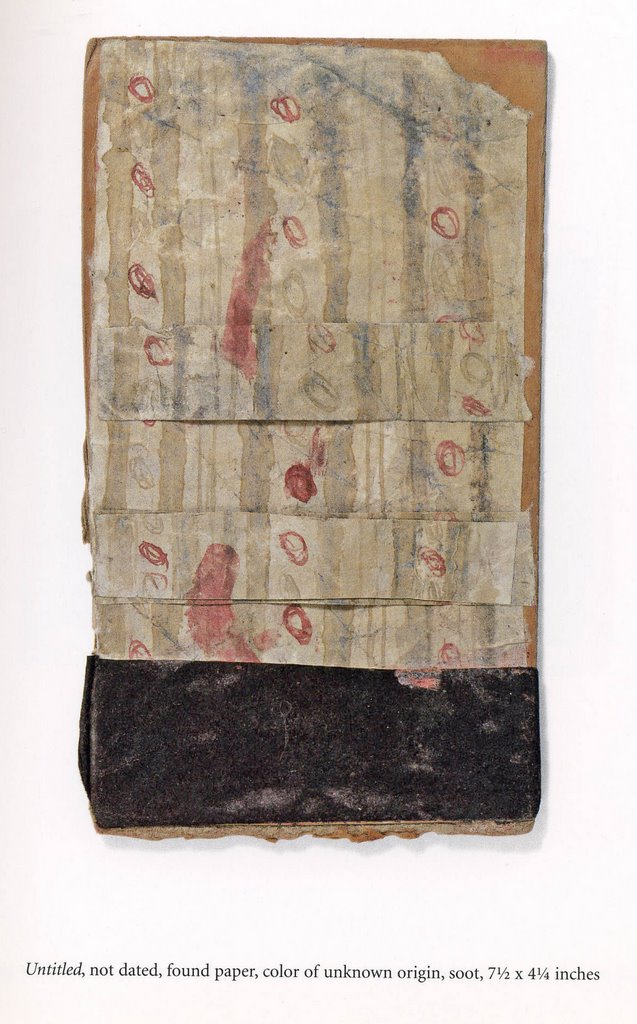
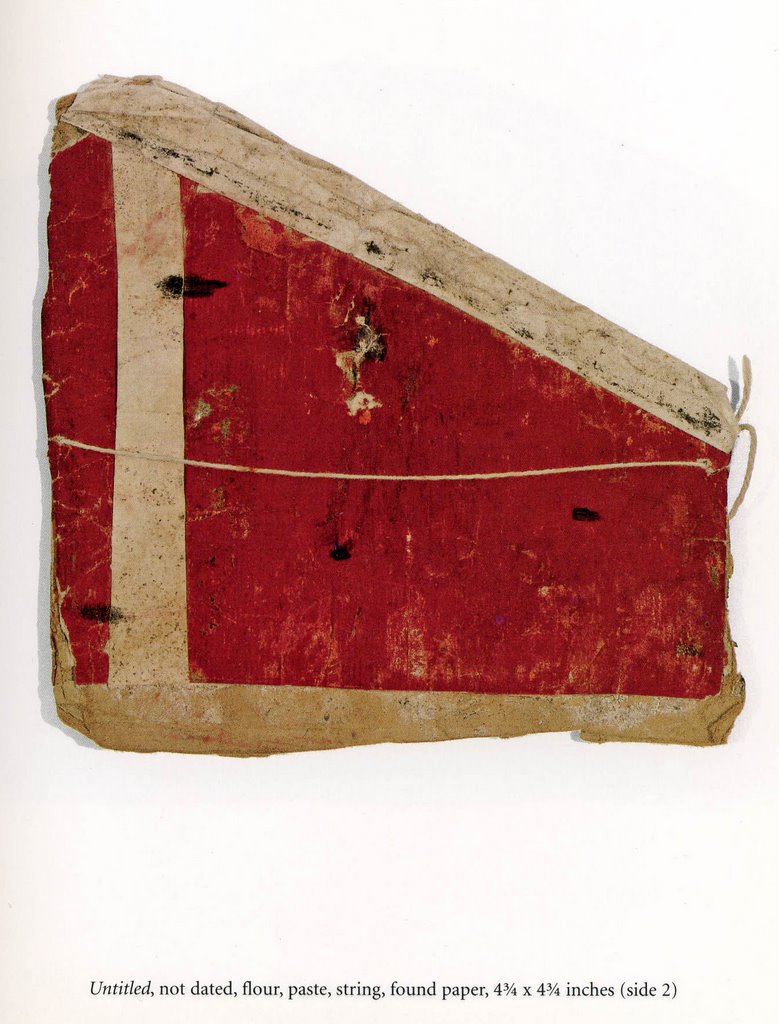
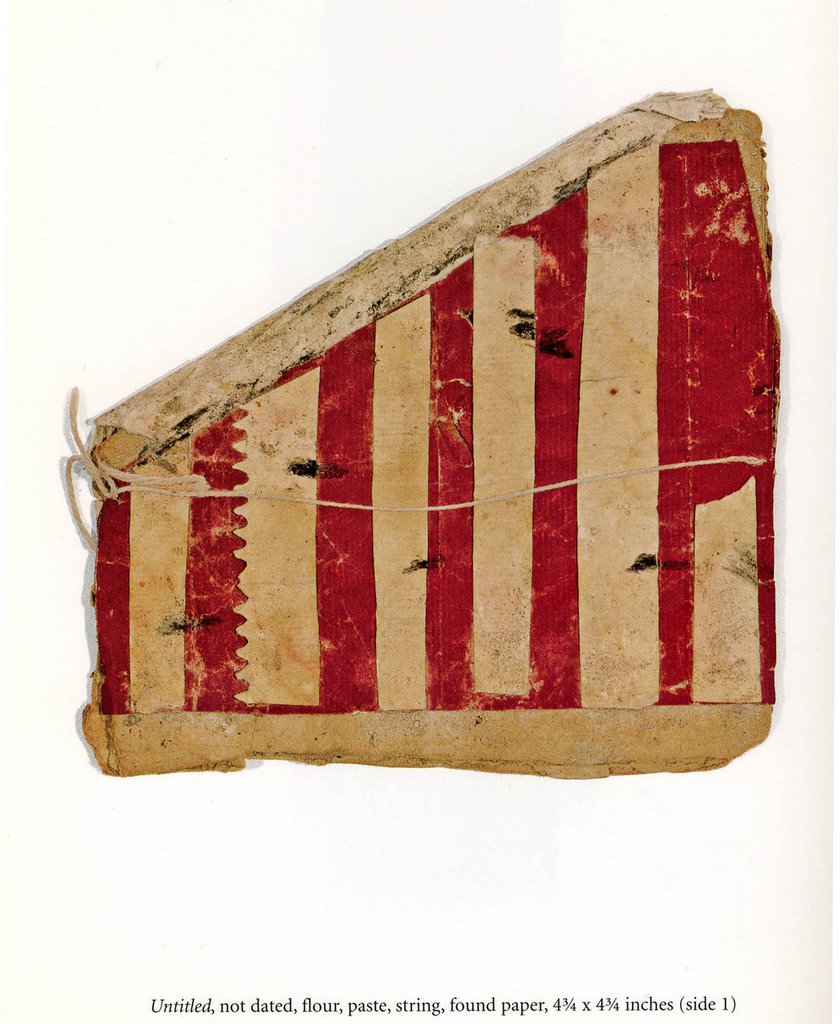
James Castle:Structures

James Castle:not casted for ArtStar
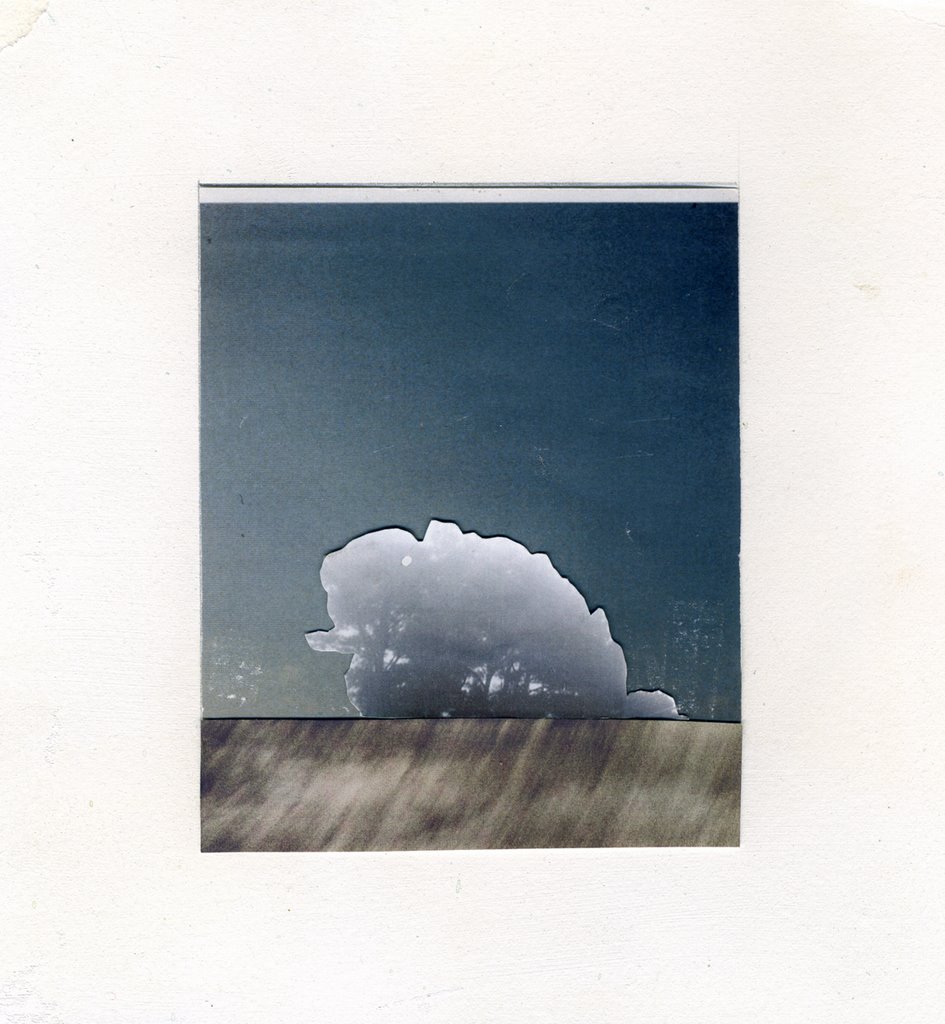
In continuing with combing the studio for “tasty bits” I came across some images by an artist that works quite differently from me but as I begin to get more involved with collage as part of my practice, I see that these pieces are rubbing off in some invisible ways.
“if one spends a long time in a room with only one object, that object becomes a little god” – Tony Smith
The artist is James Castle, now deceased since the 1970’s – from rural Idaho. What’s remarkable aside from the staggering consistency within the work is that Castle was deaf and unable to speak or sign - for his entire 77 years. His time was mostly spent making objects and drawings from found materials, cardboard, string, paper and soot. His was a lifetime devoted to art and spending most of that time alone with simple objects – a bed, a chair, a stove. An American monastic vision for sure. I’m just struck by how simple and emotional these works are and how they actually feel formidable despite being made of the most fragile and tattered things. You see every decision yet each piece feels like it was born – always just as it is.
Its tough to choose these but here’s a small sample:


Wednesday, August 09, 2006
The Apparition
So with some time off this week I have managed to get back to the paint. It's been a good few days and I'm starting to get that edge back, the sense and focus that only comes from daily practice. It hasn't been easy with all the international calamity that continues to creep and seep into every crevice - and the movie being filmed on my block only adds to the cacophony - but some brights spots have emerged such as the Ned LaMont victory and well being able to paint regularly. With 10 hour days in studio you get to shuffle through yer shit - figuratively and literally - always coming upon some arcane part of your history.
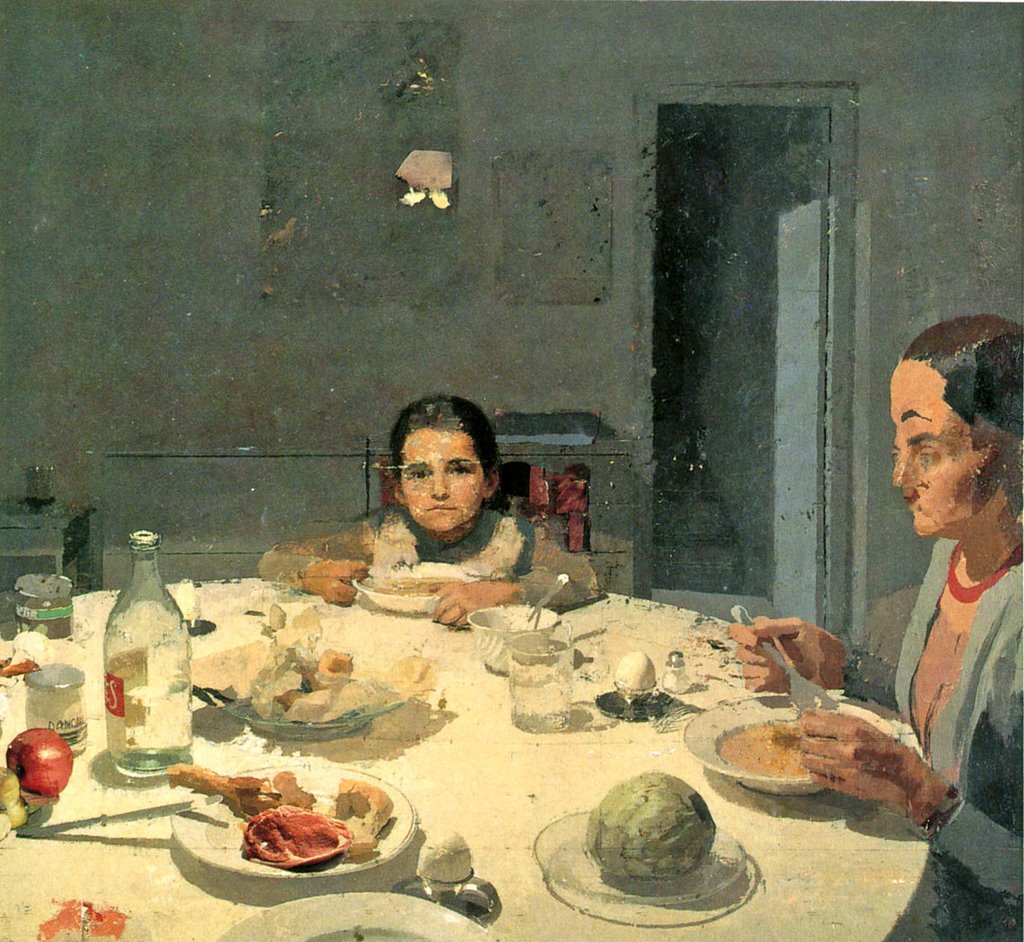
The image above has been with me in my studio for roughly 12 years, pinned onto and under various competing pictures and ephemera for the purpose of clueing me into something when I get stumped. I haven't noticed it much lately but today it jumped forth as it has many many times before.
The painting is titled, La Cena and is by the Spanish realist, Antonio Lopez Garcia. I've never seen it in person though I have seen a dozen or so paintings of his in the flesh. Doesn't seem to matter though because it always feels real even as a color copy - something I'd argue to be fascinating in itself.
At the time of this reproduction the work was unfinisihed, and I personally hope it is still just as unfinished/finished as it appears here. It's a masterpiece. That being said, I could see it continuing on its journey forever, changing each season for the entire duration of the artist's life. Always holding some new light, a variation here and there, cradling a new edge of investigation. The same scene forever still but always moving in place. The phenoma themselves fully seen and continually reassesed, painstakingly. It is such an anti-media piece, this is the no-frills Spanish painting tradition.
There is generosity in this picture, the slightest detail is given great egalatarian regard. Everything matters here, the tiny flourishes and modulated pigments are graces in themselves- interlocking, never shouting, always becoming the everyday, always inconclusive. Which is to say the real event.
Tuesday, August 08, 2006
Beliefs: The War(s) no one can win

It’s been record heat the last two weeks nationwide and admittedly, last week in NYC felt like hell at times. Staying focused and for that matter hopeful hasn’t been easy with many personal setbacks and no less a new battle with Verizon, an old nemesis when it comes to consistent communications. Needless to say I have been beset by negativity and at times despair over being a working artist who is frankly not getting ahead – yet trapped in a maze of constant activity, where the pursuit of intangibles feels so obscured by the daily grind of work, commuting, and bill paying.
But I’m lucky, as most of us are, quite lucky, quite privileged in many or all regards. Sure I have a nameless role in an organization that supports artists across the country and the world at large- an occupation where I am under payed, overworked, and never appreciated by all parties involved in the equation. I can say the same for most of my co-workers on that front too. I am however alive today. I am not maimed by the bombs that are destroying countless lives throughout Lebanon, Iraq, and Israel.
Countless blogs have been posting from within and without Lebanon over these last 3 weeks and to read them is sobering – achingly sobering. The same can be said of the Iraqi blogs that have been able to maintain themselves through 3 years of endless bloodshed and broken promises. These are testimony to the human spirit in contrast to the nightmare of human political enterprise.
In the course of these 3 weeks I have seen a groundswell of anti-Israeli graffiti spring up around me. It’s plastered all over the subways, in the elevators and hallways of the buildings that are part of my normal routine. Somewhat reminiscent of similiarly angry tags that sprouted from the 911 tragedy – political critique bordering on hate and some outright hate.
Its hard to even fathom what Israeli generals think they are accomplishing with a brutal campaign against civilians or what Hezbollah thought they would succeed in doing with that ill advised “border crossing” three weeks back. On one level it was surely a test of PM Olmert, to see what the new guy was made of. Well now we know, an iron fist. It seems a marked departure for one of the architects of the Gaza West Bank pullout. It’s difficult to watch the agony of the civilians in Lebanon. They have now suffered decades, prisoners to other people’s wars- Syrian, Palestianian, Iranian, Israeli. Historically, today seems all too familiar for such a small country.
As the shelling continues Pope Benedict and Ayatollah Sistani have both repeatedly called for a ceasefire. Both have been met with silence and perhaps a political lesson. The real powers don’t want to hear from them unless they can be used in a rhetorical moral battle to stir up unmitigated hate from the unwashed masses. If it’s a call for peace or level headedness, then these men are quickly reminded of how antiquated their social and spiritual role actually is within the world of real politik. It’s a disgrace in itself as both represent millions – singularly and collectively.
So what is behind this – a war which seems more planned than reactionary?
Is it the Judeo-Christian hate machine unleashed as so many taggers want to purport? Doubtful as an awfully large number of Christians are the victims. These are a segment of Middle Eastern culture almost always forgotten by the right and left, and far too often squeezed out by the competing interests of Sunni, Shia and Israeli. Where are all the evangelicals- Dobson, Falwell, Robertson? Only the Pope has spoken for these people. I presume the rest are consumed by their Christian-Zionism, their lust for armageddon. Their peculiar brand of nihilism wants more than anything to find secret knowledge within the events of this war – that secret knowledge being arcane “prophesy”. This theological/political obsession of “end times” precludes them from seeing the human tragedy that is unfolding at an alarming pace.
What does feel likely to me about all of this is that this is perhaps the first real all out war over resources. This will become regional quickly. A lot of parts of the puzzle are coming together now. This is a core versus periphery conflict and the prize is natural gas and oil reserves. Iran has the second highest of both in the entire world.
Look at some recent events. The Saudis just made two multi $billion arms deals with France and the US. Iran has made similar deals with Russia and Venezuela.
China has wooed Iran as well, making efforts to step up its presence in the Middle East as well oil rich areas of Africa. You can feel the polarization happening pretty quickly. India is a player here too. Iran, by luck or sly design is ready to make a push to be the regional power. It is their historic time and in some Shia minds, a theological destiny to reclaim the upper hand within Islam itself. The Saudis seem to be stockpiling as a precaution as they and Israel are the only true roadblocks to Iranian regional dominance.
Iran knows where they fit on the Neo-Con roadmap – the bull’s eye. Thus they have made fast friends with Security Council members, China and Russia. It’s not just about business and nuclear power, but political clout and personal protection. This all is a prelude to war with Iran – you can count on that war unless cooler heads come to surface. The stakes are high – energy supremacy for the next 40 years.
So what of Israel? Well many of my Israeli friends will quickly say this is about their own survival and that Olmert is just showing their strength (and I’d argue their weakness). I know several people who will perhaps be called up from reserves if this doesn’t stop soon. Many of their peers already have. It’s a depressing thought.
Israel has its personal reasons, its grudge against Hezbollah(and by extension Hamas) but who is allowing this to continue on? The Neo-Con agenda as executed by various principals here in the US and Britain. It’s a gamble for sure. They think that through destruction they can implement their utopia of proxy states. Funny how they repeatedly like to gamble with innocent lives and if it fails? Well then just retreat to some think tank or corporate board unscathed.
Lebanon is the direct ticket to Syria and the quite weak Assad. If Syria can be dismantled along with Lebanon then it creates a vacuum (one which will bite us in the ass) that can be filled by pro-US/EU interests as a counter point to Iran.
When will people learn that this never works? It simply creates more enemies and failed states. All these plans are implicitly immoral and incompetently executed to add insult to injury. Regular people suffer – and for generations. It’s a dangerous game for all players because the balance and luck can quickly tip out of control. The Middle East is full of angry, impoverished people – most under the age of 30. These forces can quickly be armed by outside interests of all stripes.
If only Democracy were the goal – but that’s just the tag line to mask the drive for natural resources. Democratization comes about culturally, not militarily.
We’re obviously running out of natural resources. Allies are no longer enough. Corporate interests want direct control of the oil and more importantly gas resources. That is the only sure way to manage the coming energy demand and remain profitable. It’s pretty obvious that was the Cheney doctrine in Iraq and Halliburton/KBR’s no bid monopoly on the oil wells and pipelines. I’m sure it informed his request of President Clinton, while CEO of Halliburton, to end the sanctions against Iraq and his request to open up talks with Iran for the purpose of energy trade. If only this energy were put into renewable energy, diplomacy and technology.
There is an irony here within the Neo-Con Middle East agenda. The invasion of Iraq actually produced a desired effect. Iran was rattled, and through the Swiss sought to go to the table with the Administration and the State Department. It could have been an opportunity to quell nuclear ambitions and make progress on other fronts. Our arrogant leadership rebuffed. Around this time Syria also leaves Lebanon as its foreign controller signaling its own political weakness within the region and its fear of invasion -a situation that is now become obsolete and squandered. Why? Because months later due to lack of forces and leadership, we became bogged down in a sectarian/civil war in Iraq. Iran has realized its new position as a leader with few restraints. Syria now thinks it acted too quickly and Assad has internal political pressure to reassert Syrian influence in Lebanon. Our military is now surrounded by enemies and battered after 3 years of futile fighting and rebuilding within Iraq. Israel is sending a message of defiance to its neighbors – do not seize the opportunity to assert regional dominance.
Meanwhile back in America, 50% of the population is still pre-occupied with those missing WMD’s that Saddam so skillfully hid or whether or not the attacks in Haifa are Biblical prophesy.
Israel seems to be making the same mistakes of the Bush camp, destroying so many innocent lives while killing any prospects of public agreement. These words seem to have been forgotten and need to be reconsidered.
Israeli PM Ehud Olmert, while Mayor of Jerusalem:
"Political leaders can help change the psychological climate which affects the quality of relationships among people." His speech concluded with reflections on the importance of political process in overcoming differences: "How are fears born? They are born because of differences in tradition and history; they are born because of differences in emotional, political and national circumstances. Because of such differences, people fear they cannot live together. If we are to overcome such fear, a credible and healthy political process must be carefully and painfully developed. A political process that does not aim to change the other or to overcome differences, but that allows each side to live peacefully in spite of their differences."In closing, I think is a helpful read, Ending the Neo-Conservative Nightmare, by Daniel Levy.
Here's a place to help those suffering in Beirut.
image: Dan Perjovschi
Wednesday, August 02, 2006
and don't forget..
...that this is the person speaking for us right now during a very serious meltdown in the Middle East.

Karen Hughes, is the official in charge of public diplomacy to the Muslim world. How many miles from Normal now?

Karen Hughes, is the official in charge of public diplomacy to the Muslim world. How many miles from Normal now?
Subscribe to:
Posts (Atom)


 Posts
Posts


